Code
1library(tidyquant)
library(plotly)- 1
-
In addition to the regular packages, here we’ll use
tidyquantandplotly.
1library(tidyquant)
library(plotly)tidyquant and plotly.
In the previous topic we introduced the two basic building blocks for modeling the correlation structure of a stationary time series:
In practice, neither model alone is usually sufficient. Real series often show patterns that require both autoregressive and moving average components simultaneously. And most real series are also non-stationary — they have trend, seasonality, or both.
If we could combine AR and MA terms and relax the stationarity requirement by incorporating differencing directly into the model, we would have a single, unified framework for a very wide range of time series.
That framework is ARIMA.
ARIMA stands for AutoRegressive Integrated Moving Average. The “Integrated” part refers to the reverse operation of differencing: if we difference a series d times to make it stationary, the model is said to be integrated of order d.
A non-seasonal ARIMA model is written as ARIMA(p, d, q), where:
The model equation, written on the differenced series y'_t, is:
y'_t = c + \phi_1 y'_{t-1} + \cdots + \phi_p y'_{t-p} + \theta_1 \varepsilon_{t-1} + \cdots + \theta_q \varepsilon_{t-q} + \varepsilon_t
where y'_t denotes the d-times differenced series and \varepsilon_t is white noise.
Recall from the previous topic that the backshift operator B satisfies By_t = y_{t-1}, and that d-th order differencing can be written as (1-B)^d y_t.
Using this notation, we can write the AR and MA components compactly as well:
AR component: \phi_1 y_{t-1} + \phi_2 y_{t-2} + \cdots + \phi_p y_{t-p} = \phi(B)\,y_t
where \phi(B) = \phi_1 B + \phi_2 B^2 + \cdots + \phi_p B^p.
MA component: \theta_1 \varepsilon_{t-1} + \theta_2 \varepsilon_{t-2} + \cdots + \theta_q \varepsilon_{t-q} = \theta(B)\,\varepsilon_t
where \theta(B) = \theta_1 B + \theta_2 B^2 + \cdots + \theta_q B^q.
Full ARIMA(p, d, q) in backshift notation:
\underbrace{(1 - \phi_1 B - \cdots - \phi_p B^p)}_{\text{AR}(p)} \underbrace{(1-B)^d}_{\text{differencing}} y_t = c + \underbrace{(1 + \theta_1 B + \cdots + \theta_q B^q)}_{\text{MA}(q)} \varepsilon_t
This compact form shows clearly how the three components interact. The differencing operator (1-B)^d is applied first, and the AR and MA operators act on the resulting stationary series.
Several models we have already encountered are special cases of the ARIMA family:
| Model | ARIMA specification |
|---|---|
| White noise | ARIMA(0, 0, 0) without constant |
| Random walk | ARIMA(0, 1, 0) without constant |
| Random walk with drift | ARIMA(0, 1, 0) with constant |
| AR(p) | ARIMA(p, 0, 0) |
| MA(q) | ARIMA(0, 0, q) |
The constant c and the differencing order d interact to determine the long-run behavior of ARIMA forecasts:
Higher values of d also produce wider prediction intervals that grow faster.
Selecting the right ARIMA order involves three decisions:
Choose d — determine how many differences are needed using the stationarity protocol from the previous topic: Box-Cox / log transformation to stabilize variance, unitroot_nsdiffs() for seasonal differencing (if any), then unitroot_ndiffs() on the differenced series.
Choose p or q — read the ACF and PACF of the (differenced, stationary) series:
Compare candidates using information criteria (see Model Selection).
Real data rarely produces textbook-perfect ACF/PACF shapes. Use the plots to narrow down candidate models, then compare them formally with AIC_c.
In fable, ARIMA models are specified inside model() using the ARIMA() function. The order is controlled with pdq() for non-seasonal terms and PDQ() for seasonal terms. When pdq() is left unspecified, fable searches for the best order automatically.
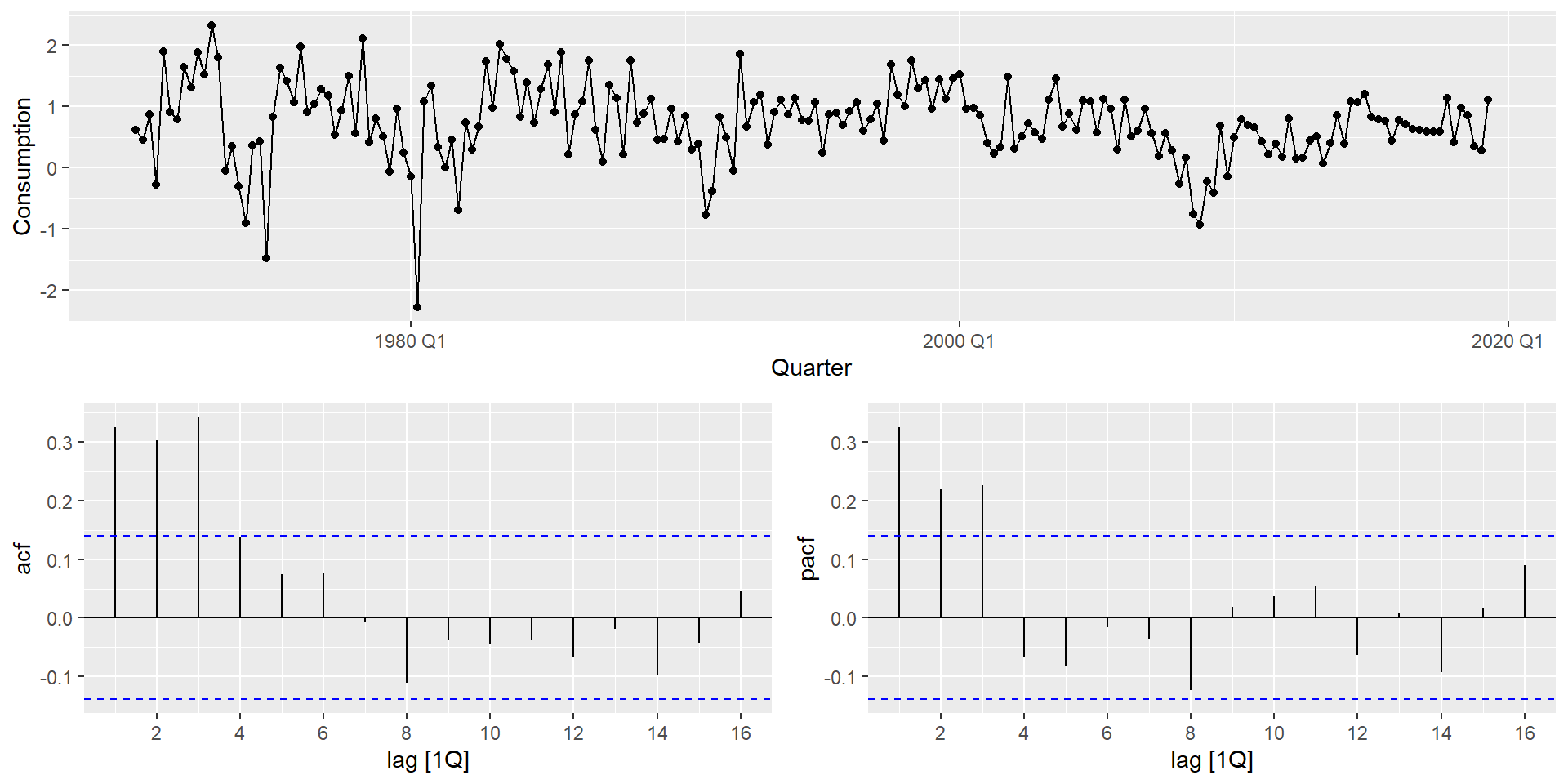
The series appears stationary (d = 0). The PACF shows significant spikes at lags 1–3, suggesting AR(3). We can fit this manually, compare it against automatic selection strategies, and let AIC_c arbitrate — all within a single mable:
us_change_fit <- us_change |>
  model(
1    manual     = ARIMA(Consumption ~ pdq(3, 0, 0) + PDQ(0, 0, 0)),
2    auto       = ARIMA(Consumption ~ PDQ(0, 0, 0)),
3    semi_auto  = ARIMA(Consumption ~ pdq(1:3, 0, 0:2) + PDQ(0, 0, 0)),
    exhaustive = ARIMA(Consumption ~ PDQ(0, 0, 0),
4                       stepwise      = FALSE,
5                       approximation = FALSE)
  )

glance(us_change_fit) |>
  arrange(AICc) |>
select(.model, AIC, AICc, BIC)pdq(). PDQ(0,0,0) explicitly forces a non-seasonal model.
pdq() unspecified triggers automatic stepwise order selection.
stepwise = FALSE explores all combinations rather than navigating step by step.
approximation = FALSE uses exact likelihood. More accurate but slower on long series.
fable implements a stepwise search algorithm (Hyndman & Khandakar, 2008) that:
Important: this is a heuristic search — it does not evaluate all possible combinations. It is fast and usually good, but not guaranteed to find the global optimum.
For exploratory work, automatic selection is fine. For a final model, use stepwise = FALSE, approximation = FALSE and compare the result with your manually identified candidate.
stepwise = FALSE, approximation = FALSE triggers a full search over all candidate models using exact likelihood. The difference in runtime can be dramatic:
tictoc::tic("auto")
us_change |>
model(ARIMA(Consumption ~ PDQ(0, 0, 0)))tictoc::toc()auto: 0.12 sec elapsedtictoc::tic("exhaustive")
us_change |>
model(ARIMA(Consumption ~ PDQ(0, 0, 0),
stepwise = FALSE,
approximation = FALSE))tictoc::toc()exhaustive: 0.75 sec elapsedTimes will vary by hardware, but the relative difference is what matters. On longer series like mexretail (480+ monthly observations with seasonal structure), the gap is even more pronounced — which is why freeze is recommended for documents containing exhaustive ARIMA searches.
When we fit a statistical model, we face a fundamental tension: a more complex model (more parameters) will always fit the observed data better, but it may simply be memorizing noise rather than capturing genuine structure. This is the bias-variance tradeoff.
Information criteria address this by penalizing model complexity — they reward goodness of fit but add a cost for each additional parameter estimated. The goal is to find the model that generalizes best, not the one that fits best in-sample.
When comparing candidate ARIMA models, we use three related criteria:
\text{AIC} = -2\log(L) + 2(p + q + k + 1)
\text{AIC}_c = \text{AIC} + \frac{2(p + q + k + 1)(p + q + k + 2)}{T - p - q - k - 2}
\text{BIC} = \text{AIC} + [\log(T) - 2](p + q + k + 1)
where k = 1 if the model includes a constant, k = 0 otherwise. Lower is better for all three. The preferred criterion is AIC_c — it converges to AIC as T grows, but is more conservative with small samples.
Both penalize complexity, but BIC applies a heavier penalty (it grows with \log T rather than a fixed 2). In practice:
For this course, use AIC_c as the default.
Information criteria are only comparable across models fitted to identical data — same transformation, same differencing order. You cannot compare AIC_c of an ARIMA fitted to \log(y_t) vs. one fitted to y_t, or ARIMA(1,1,1) vs. ARIMA(1,0,1). When models differ in d, use forecast accuracy on a test set instead.
ARIMA model building follows an iterative procedure known as the Box-Jenkins methodology:
unitroot_nsdiffs() and unitroot_ndiffs().The Box-Jenkins procedure is a cycle, not a checklist. It is normal to go through steps 4–6 two or three times before settling on a model.
We have already used the Ljung-Box test to check residuals from benchmark models. When applying it to ARIMA models, there is one important adjustment: you must account for the degrees of freedom consumed by the estimated AR and MA parameters.
us_change_fit |>
  select(manual) |>
  gg_tsresiduals()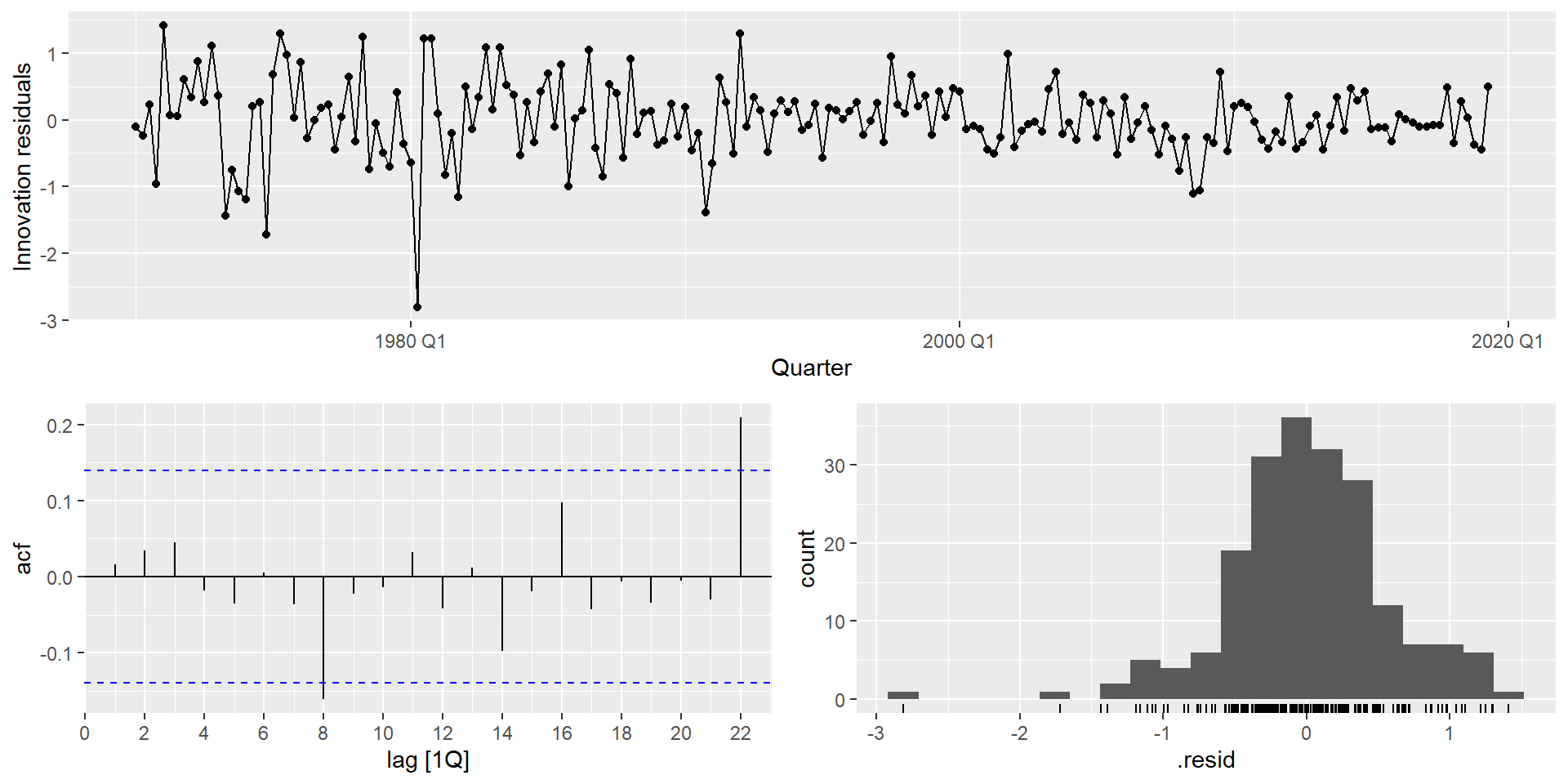
us_change_fit |>
  select(manual) |>
  augment() |>
  features(.innov, ljung_box,
           lag = 10,
1           dof = us_change_fit |>
                   select(manual) |>
                   coefficients() |>
                   filter(str_detect(term, "^ar|^ma")) |>
nrow())dof is computed dynamically as the number of estimated AR and MA coefficients, so it always matches the fitted model regardless of order.
Once the model passes residual diagnostics, forecasting uses the same forecast() workflow as all other fable models:
us_change_fit |>
  select(manual) |>
  forecast(h = 10) |>
  autoplot(us_change |> filter(year(Quarter) >= 2005)) +
  labs(
    title = "US consumption — ARIMA(3,0,0) forecast",
    y = "% change"
  )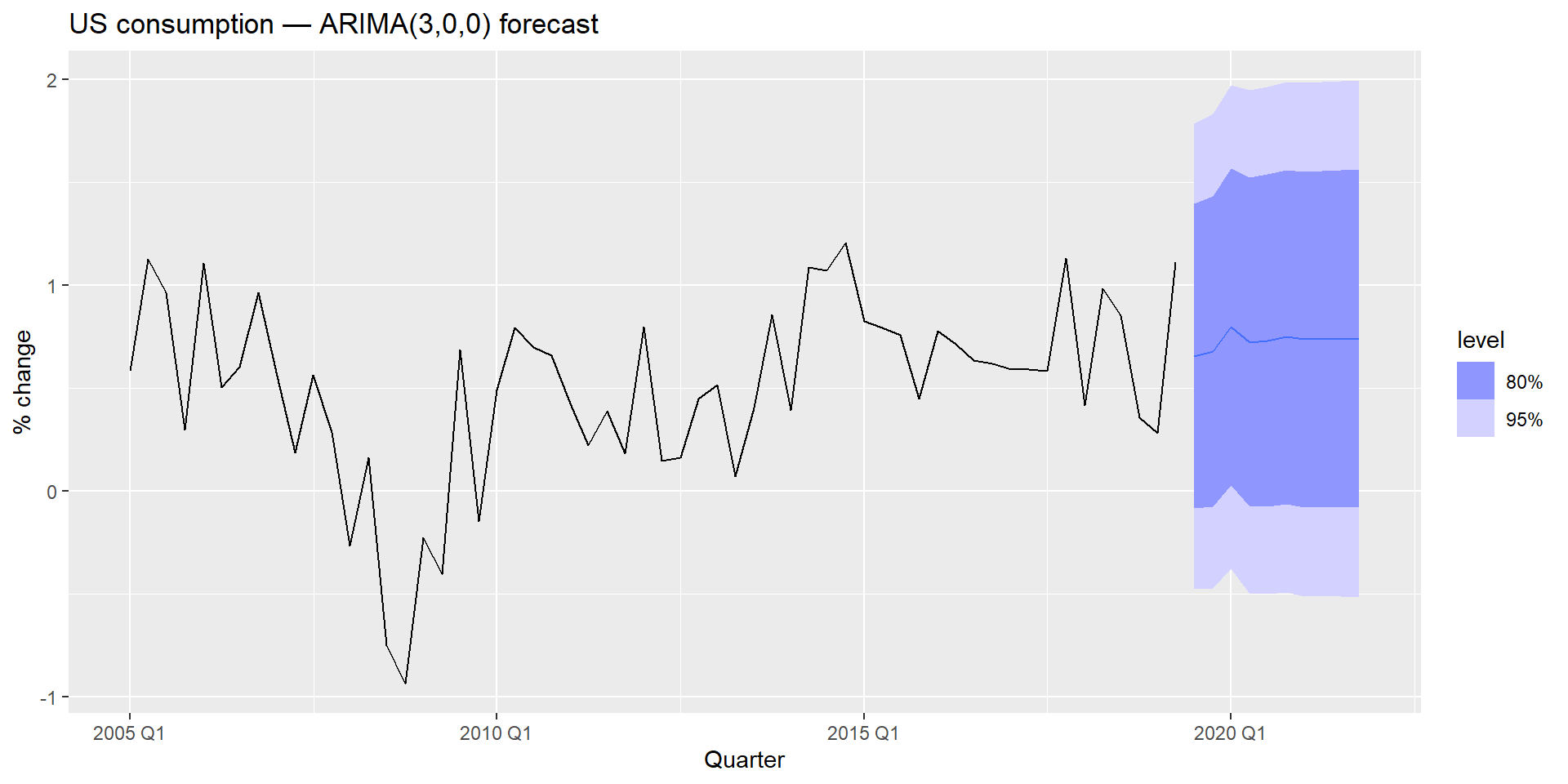
ARIMA prediction intervals are derived analytically from the model’s MA representation. Their width grows with the forecast horizon, and grows faster as d increases — a direct consequence of accumulated uncertainty from differencing. For a random walk (d = 1), intervals widen at rate \sqrt{h}; for d = 2, they widen even faster.
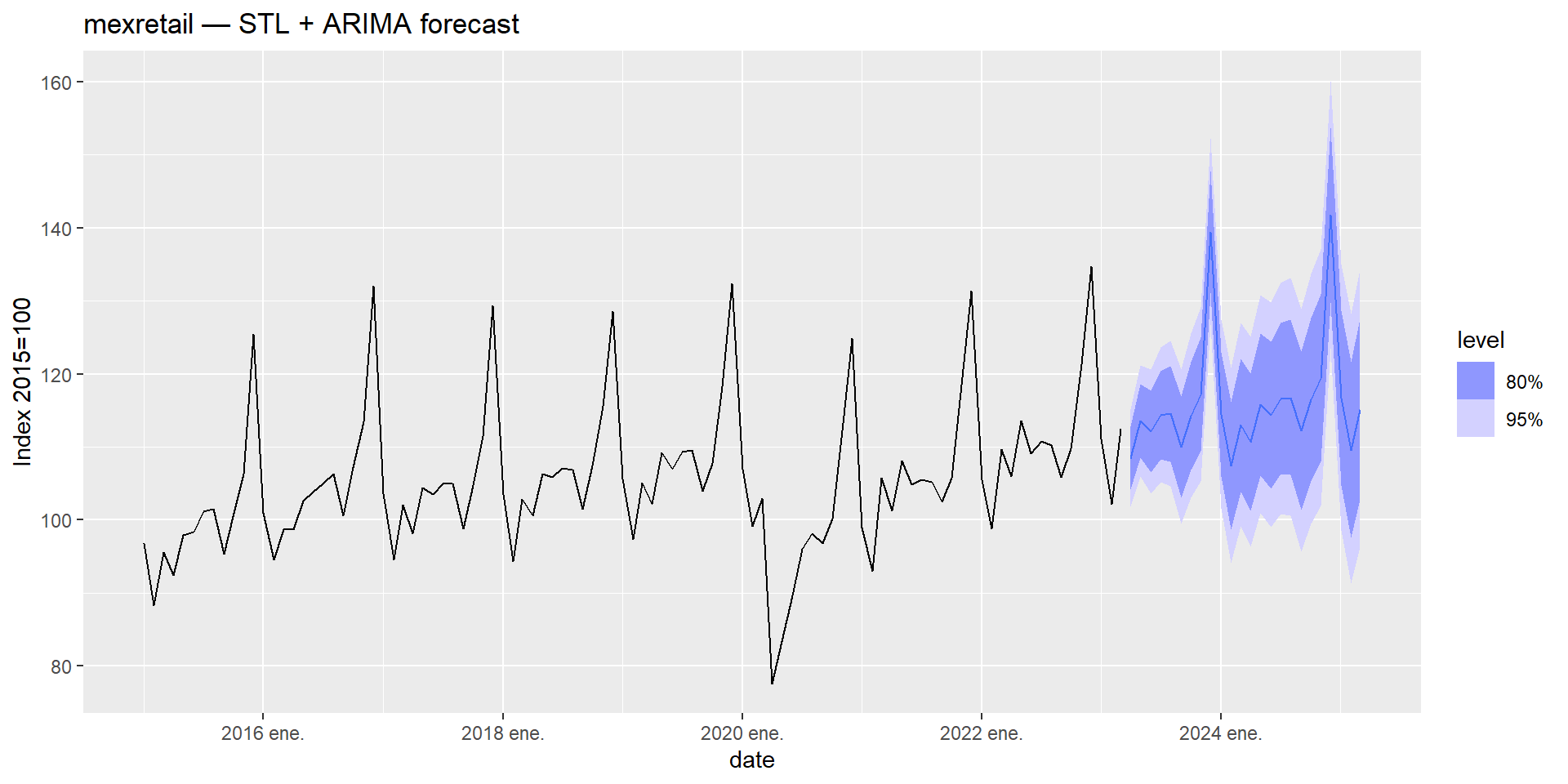
mexretail is a monthly series with strong trend and seasonality. We already know how to handle it with STL decomposition. In Module 1 we combined STL with SNAIVE; in Module 2 we replaced SNAIVE with ETS. The natural next step is to replace it with ARIMA.
The idea is the same: use STL to handle the seasonal pattern, and let ARIMA model the trend-cycle on the seasonally adjusted series.
decomposition_model() combines a decomposition method with a model for one or more of its components.
ARIMA(season_adjust) fits an ARIMA model automatically to the seasonally adjusted component. The seasonal part is re-added when generating forecasts.
Series: y
Model: STL decomposition model
Transformation: box_cox(y, lambda)
Combination: season_adjust + season_year

========================================

Series: season_adjust
Model: ARIMA(0,1,1) w/ drift

Coefficients:
          ma1  constant
      -0.4500    0.1007
s.e.   0.0433    0.0491

sigma^2 estimated as 3.553:  log likelihood=-914.69
AIC=1835.38   AICc=1835.43   BIC=1847.68

Series: season_year
Model: SNAIVE

sigma^2: 0 mexretail_fit_stl_arima |> gg_tsresiduals()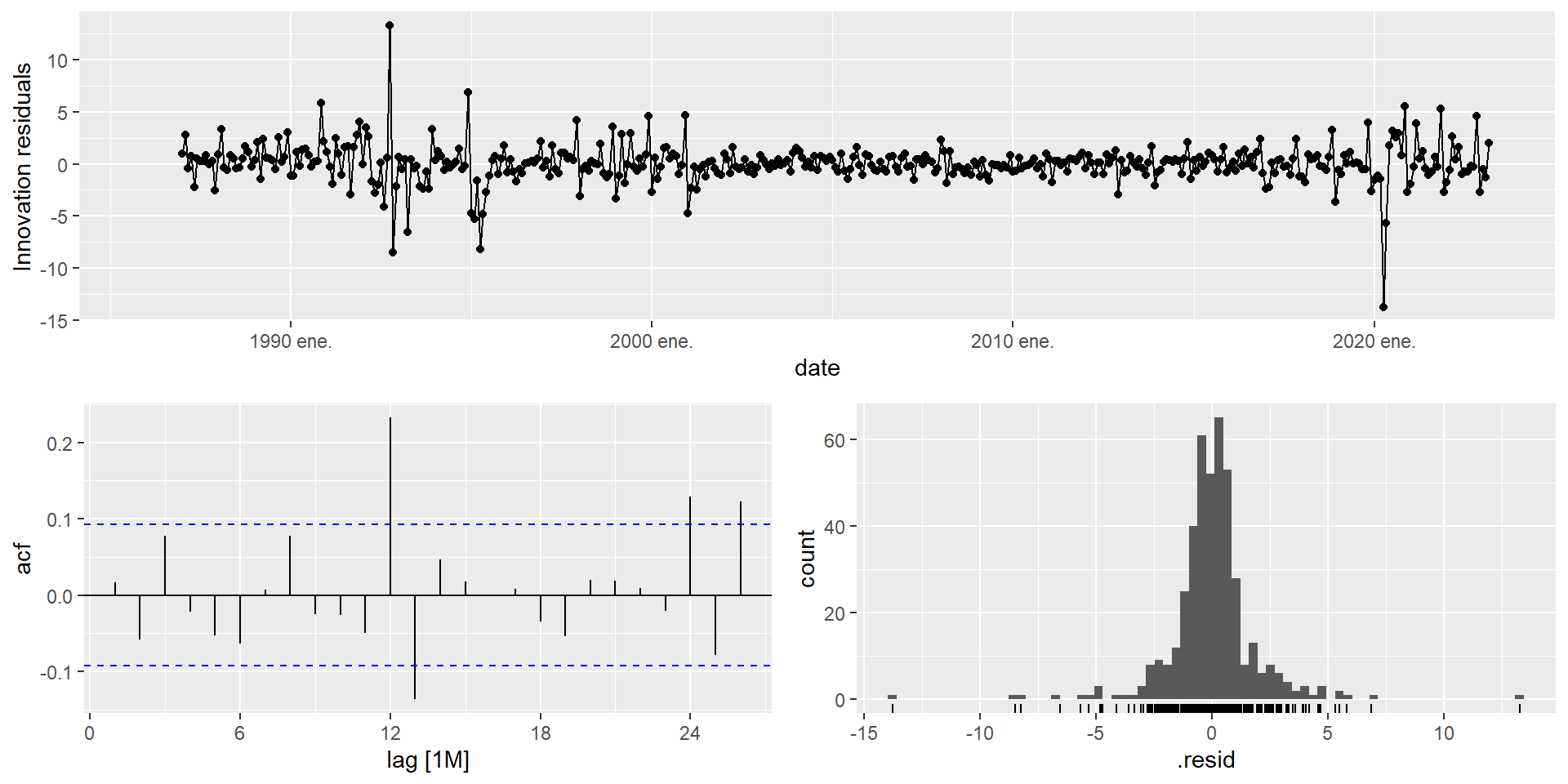
mexretail_fit_stl_arima |>
  forecast(h = 24) |>
  autoplot(mexretail |> filter(year(date) >= 2015)) +
  labs(
    title = "mexretail — STL + ARIMA forecast",
    y = "Index 2015=100"
  )
STL + ARIMA is a two-stage approach: decompose first, then model. An alternative is to handle seasonality within a single ARIMA model by adding seasonal AR and MA terms. This is a Seasonal ARIMA model, written as:
\text{ARIMA}\underbrace{(p,\,d,\,q)}_{\text{non-seasonal}}\underbrace{(P,\,D,\,Q)_{m}}_{\text{seasonal}}
where m is the seasonal period (m = 12 for monthly data).
The full model in backshift notation is:
\underbrace{\Phi(B^m)}_{\text{seasonal AR}} \underbrace{\phi(B)}_{\text{non-seasonal AR}} \underbrace{(1-B^m)^D (1-B)^d}_{\text{differencing}} y_t = c + \underbrace{\Theta(B^m)}_{\text{seasonal MA}} \underbrace{\theta(B)}_{\text{non-seasonal MA}} \varepsilon_t
The non-seasonal orders (p, q) are read from the first few lags of the ACF/PACF, as before. The seasonal orders (P, Q) are read from the seasonal lags (m, 2m, 3m, …):
| Pattern at seasonal lags | Suggested component |
|---|---|
| PACF spikes cut off after lag Pm | Seasonal AR(P) |
| ACF spikes cut off after lag Qm | Seasonal MA(Q) |
| Both decay gradually | Mixed seasonal ARMA |
Focus on the seasonal lags separately from the non-seasonal lags. Use lag_max = 3m or 4m to make the seasonal structure clearly visible.
mexretailThe stationarity protocol for mexretail established that we need D = 1 and d = 1 applied to the Box-Cox-transformed series. Let’s inspect the ACF/PACF to choose p, q, P, Q:
mexretail |>
  gg_tsdisplay(
    difference(box_cox(y, lambda), 12) |> difference(1),
    plot_type = "partial",
    lag_max   = 48
  )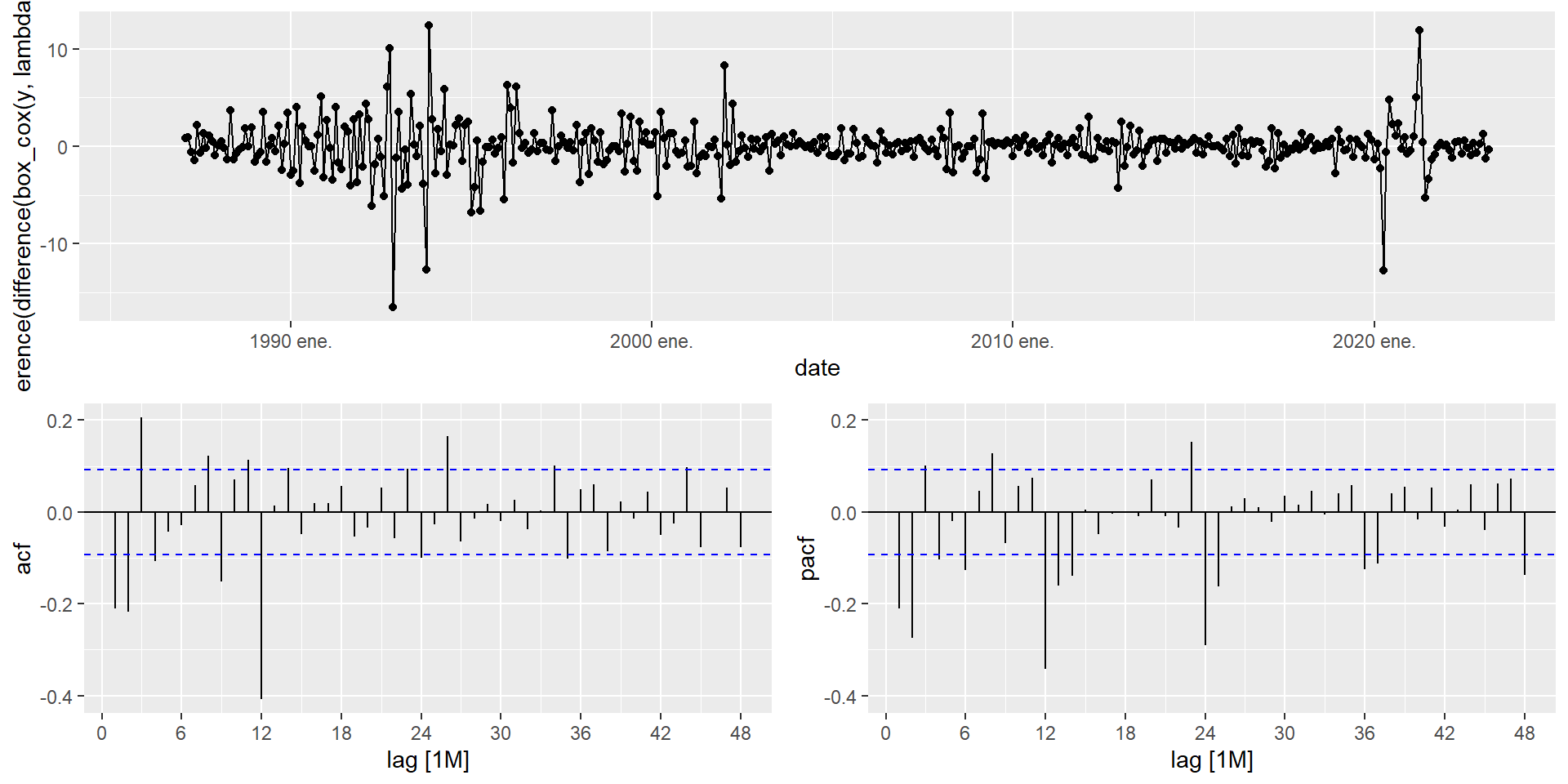
A strict reading of the ACF/PACF above could justify orders as large as AR(3), MA(4), SAR(4), SMA(2) — a model with over a dozen parameters. In practice, this is rarely a good starting point: high-order models are harder to estimate, more prone to overfitting, and — if specified manually — can fail to converge or return non-invertible roots altogether.
A better strategy: start with a parsimonious candidate like \text{ARIMA}(0,1,1)(0,1,1)_{12} or \text{ARIMA}(1,1,1)(1,1,1)_{12}, fit a few of the larger candidates suggested by the plots, and let AIC_c arbitrate. You will often find that the simpler model performs comparably or better — and it will always be more stable.
mexretail_fit_sarima <- mexretail |>
  model(
    sarima_011_110 = ARIMA(box_cox(y, lambda) ~
1                             pdq(0, 1, 1) + PDQ(1, 1, 0)),
    sarima_011_011 = ARIMA(box_cox(y, lambda) ~
2                             pdq(0, 1, 1) + PDQ(0, 1, 1)),
3    sarima_auto    = ARIMA(box_cox(y, lambda),
                           stepwise      = FALSE,
                           approximation = FALSE)
  )

glance(mexretail_fit_sarima) |>
  arrange(AICc) |>
select(.model, AIC, AICc, BIC)mexretail_fit_sarima |>
select(sarima_auto) |>
report()Series: y
Model: ARIMA(3,0,1)(0,1,2)[12] w/ drift
Transformation: box_cox(y, lambda)
Coefficients:
ar1 ar2 ar3 ma1 sma1 sma2 constant
0.2930 0.3114 0.3143 0.3671 -0.6877 -0.0956 0.0931
s.e. 0.1848 0.1454 0.0521 0.1975 0.0526 0.0534 0.0274
sigma^2 estimated as 3.303: log likelihood=-879.31
AIC=1774.62 AICc=1774.95 BIC=1807.22mexretail_fit_sarima |>
select(sarima_auto) |>
gg_tsresiduals(lag_max = 48)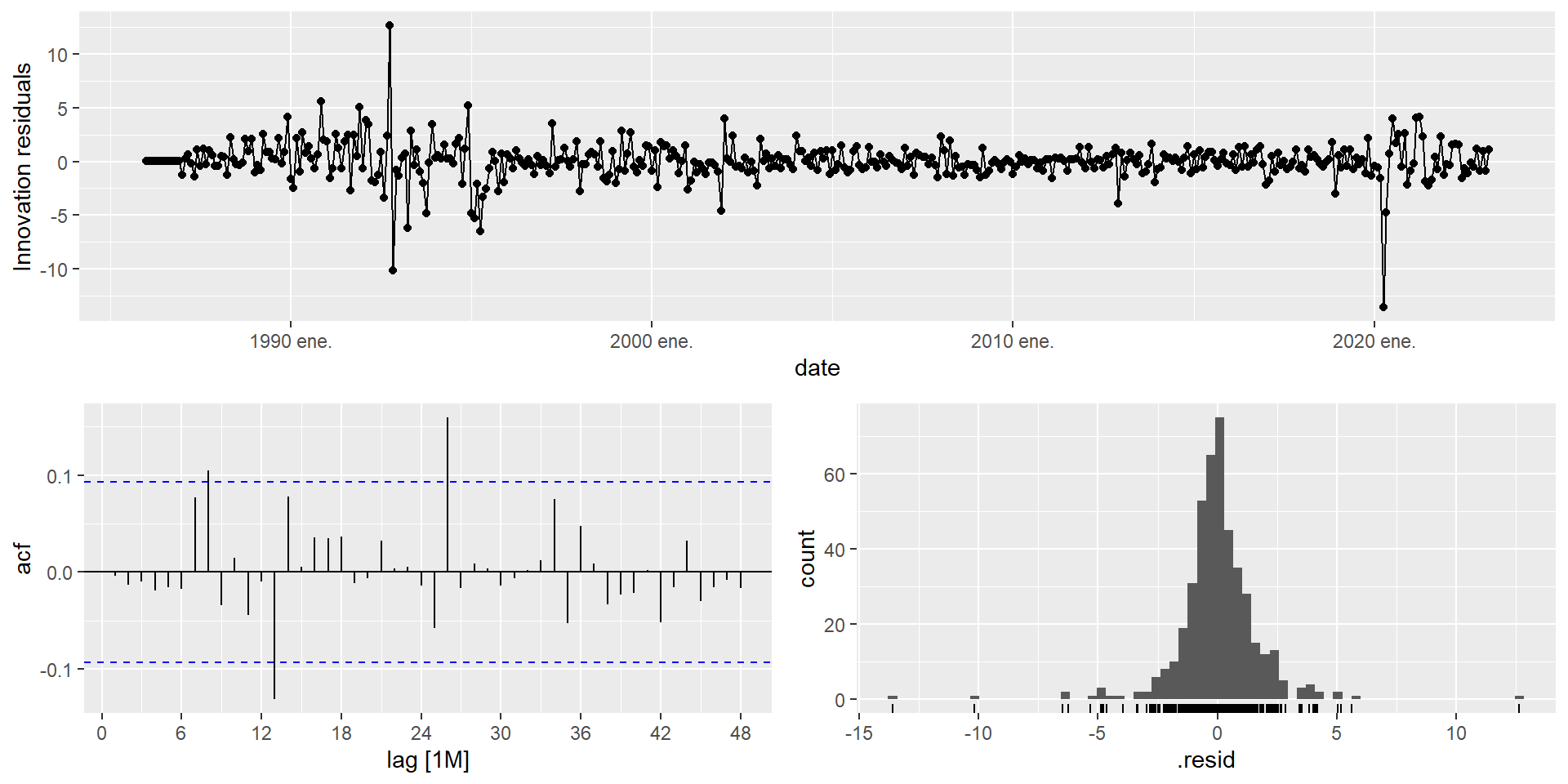
mexretail_fit_sarima |>
  select(sarima_auto) |>
  augment() |>
  features(.innov, ljung_box,
           lag = 24,
1           dof = mexretail_fit_sarima |>
                   select(sarima_auto) |>
                   coefficients() |>
                   filter(str_detect(term, "^ar|^ma|^sar|^sma")) |>
nrow())dof is computed dynamically as p + q + P + Q for the fitted model, so it always reflects the actual order selected by the exhaustive search.
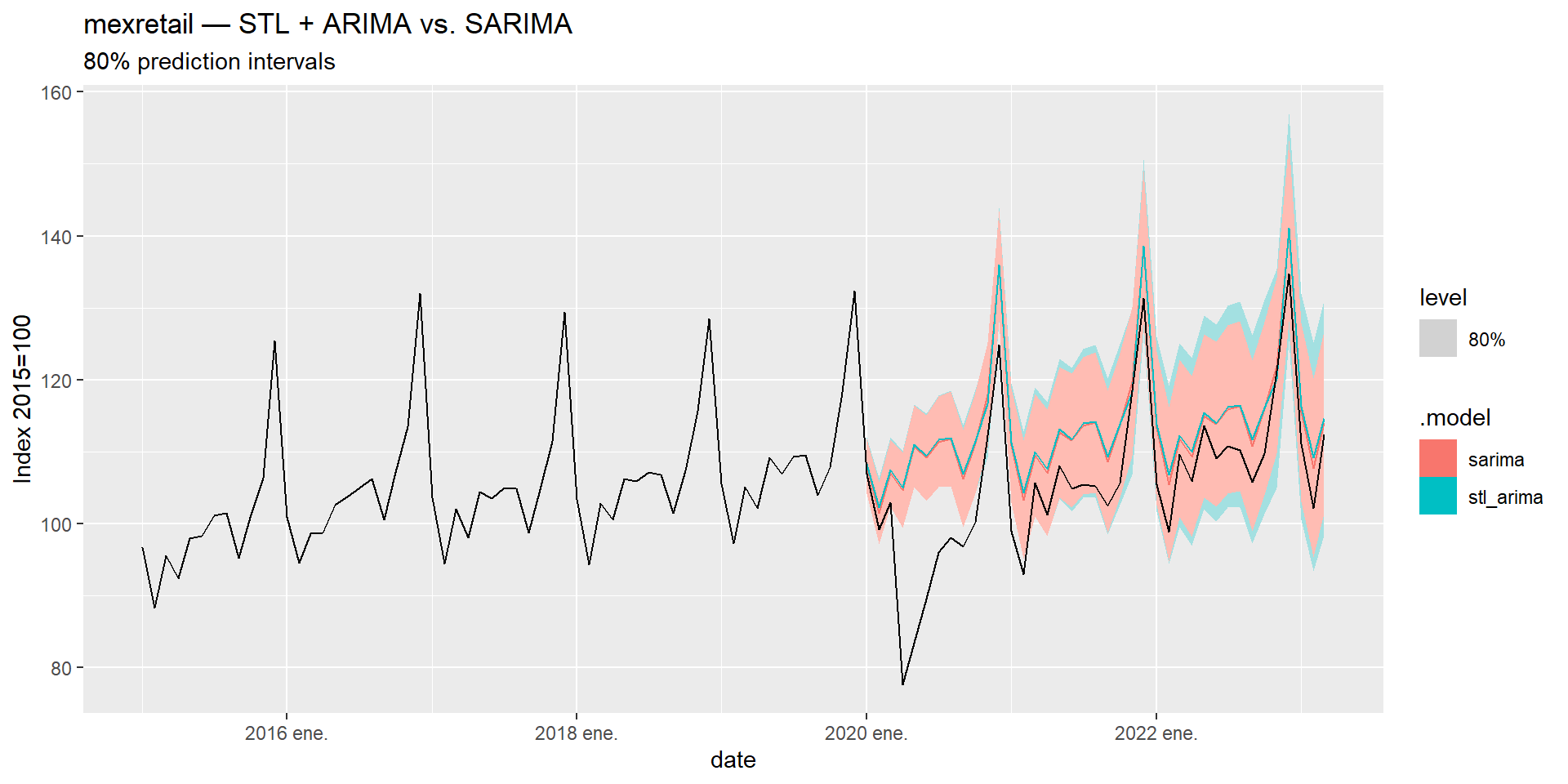
Both approaches are valid for seasonal series. Let’s compare them on mexretail using a train/test split:
mexretail_train <- mexretail |> filter(year(date) <= 2019)
mexretail_test <- mexretail |> filter(year(date) > 2019)mexretail_fit <- mexretail_train |>
model(
stl_arima = decomposition_model(
STL(box_cox(y, lambda) ~
trend(window = NULL) +
season(window = "periodic"),
robust = TRUE),
ARIMA(season_adjust)
),
sarima = ARIMA(box_cox(y, lambda),
stepwise = FALSE,
approximation = FALSE)
)mexretail_fit |>
forecast(h = nrow(mexretail_test)) |>
accuracy(mexretail) |>
select(.model, RMSE, MAE, MAPE, MASE) |>
arrange(RMSE)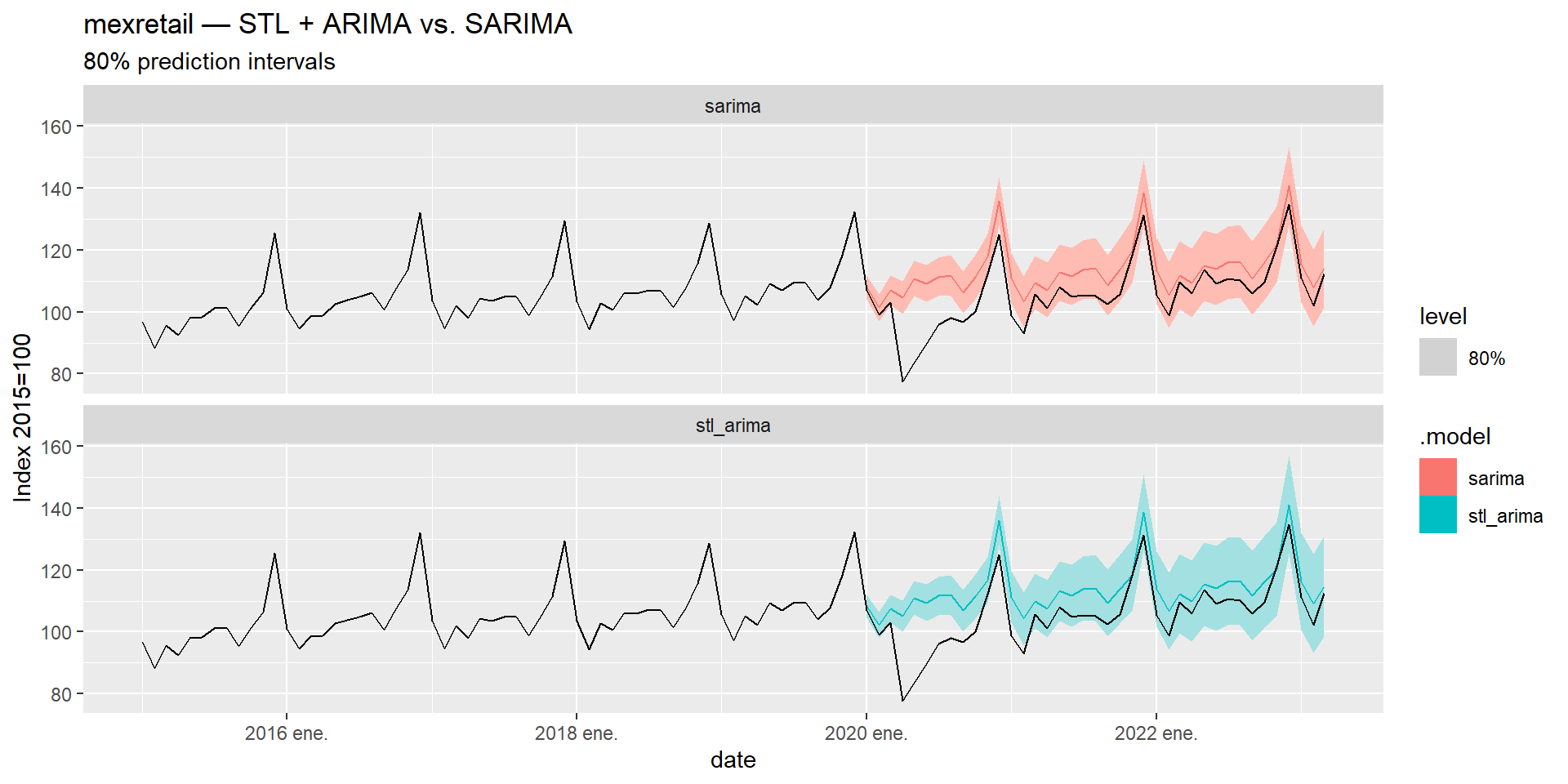
| STL + ARIMA | SARIMA | |
|---|---|---|
| Seasonal pattern | Flexible — can change over time | Fixed structure |
| Outlier robustness | High (with robust = TRUE) |
Lower |
| Interpretability | Decomposition is visible | Single compact model |
| Multiple seasonality | Handles it naturally | Difficult |
| Parsimony | Two models in sequence | One unified model |
Neither approach dominates universally. Let the data and the accuracy metrics guide the choice.