
Getting Started with psvr
getting-started.RmdIntroduction
Classical SVR minimises absolute-error losses (MAE, MSE), which are misaligned with the scale-free accuracy criteria standard in forecasting. An error of 1 unit is negligible when the target is 1 000 but large when it is 2.
psvr implements four SVR variants derived from percentage-error loss functions (Benavides-Herrera et al., 2026), accessed through one fitter per model family:
| Model | Function | sym_type |
Solver |
|---|---|---|---|
| 1 | psvr_mape() |
"none" |
quadratic program |
| 2 | psvr_mape() |
"even" / "odd"
|
quadratic program |
| 3 | psvr_rmspe() |
"none" |
linear system |
| 4 | psvr_rmspe() |
"even" / "odd"
|
linear system |
sym_type = "even" enforces even symmetry
f(x) = f(-x); "odd" enforces odd symmetry. Use
the symmetric variants only with kernels that satisfy Assumption 3 of
the paper (RBF and even-degree polynomial kernels do).
These are the two direct fitters. They replaced the unified
psvr() entry point in 0.0.2.9012, which had in turn
replaced four separate wrappers in 0.0.2.9010: seven of
psvr()’s eleven arguments were conditional on which family
you were fitting, so the families are now separate functions. Both
return the same classes the tidymodels engine returns, so a fit obtained
either way behaves identically.
All models require strictly positive targets
(y > 0), which is the condition under which percentage
residuals are well-defined.
Fuel-economy data
This vignette demonstrates the package on a small public dataset.
We use ggplot2::mpg: 234 records of US passenger
vehicles. The target is hwy, highway fuel economy in miles
per gallon. It is strictly positive on every observation, so the
percentage residuals — and therefore MAPE and RMSPE — are well-defined
throughout.
library(psvr)
library(ggplot2)

# Target: highway fuel economy (all > 0)
y_all <- mpg$hwy

# Predictors: engine displacement, model year, cylinder count.
#
# `cty` is deliberately EXCLUDED. City and highway fuel economy are two
# measurements of the same property of the same vehicle (they correlate at
# 0.96), so predicting one from the other is leakage rather than modelling.
X_raw <- as.matrix(mpg[, c("displ", "year", "cyl")])

stopifnot(all(y_all > 0))
cat("N =", nrow(X_raw), "  p =", ncol(X_raw),
    "  y range: [", min(y_all), ",", max(y_all), "]\n")
#> N = 234   p = 3   y range: [ 12 , 44 ]
70 / 30 train–test split
Features are standardised using training-set statistics so that the RBF kernel operates on a comparable scale across all three predictors.
set.seed(42)
n      <- nrow(X_raw)
tr_idx <- sample(n, floor(0.7 * n))

X_raw_tr <- X_raw[tr_idx, ];  y_tr <- y_all[tr_idx]
X_raw_te <- X_raw[-tr_idx, ]; y_te <- y_all[-tr_idx]

# Standardise: centre and scale by training mean/sd
col_mean <- colMeans(X_raw_tr)
col_sd   <- apply(X_raw_tr, 2, sd)
X_tr <- scale(X_raw_tr, center = col_mean, scale = col_sd)
X_te <- scale(X_raw_te, center = col_mean, scale = col_sd)Baseline: linear regression
lm_df_tr <- as.data.frame(X_tr)
lm_df_te <- as.data.frame(X_te)
lm_fit   <- lm(y_tr ~ ., data = lm_df_tr)
lm_pred  <- predict(lm_fit, newdata = lm_df_te)

cat(sprintf("Linear regression — MAPE: %.2f%%  RMSPE: %.2f%%  R²: %.4f\n",
            mape(y_te, lm_pred), rmspe(y_te, lm_pred), r2(y_te, lm_pred)))
#> Linear regression — MAPE: 12.91%  RMSPE: 17.65%  R²: 0.6391
Model 1: ε-SVR with MAPE
The ε-SVR formulation optimises a QP with sample-dependent box constraints : tighter bounds for small targets, concentrating model capacity on low-magnitude observations.
# make_kernel() returns a closure K(xi, xj) = exp(-||xi - xj||^2 / (2 sigma^2)).
# sigma is a LENGTH in the units of the preprocessed feature space, so it has
# to be set on that scale -- sigma_heuristic() reads it off the data instead of
# guessing. See "Hyperparameter search ranges" below.
K <- make_kernel("rbf", sigma = sigma_heuristic(X_tr))

# C = 10: per-sample box bound |beta_k| <= 100*C/y_k; eps = 1: tube width (% of y_k)
fit_ep <- psvr_mape(X_tr, y_tr, kernel = K, C = 10, eps = 1)
pred_ep <- predict(fit_ep, X_te)

cat(sprintf("ε-SVR MAPE    — MAPE: %.2f%%  RMSPE: %.2f%%  R²: %.4f\n",
            mape(y_te, pred_ep), rmspe(y_te, pred_ep), r2(y_te, pred_ep)))
#> ε-SVR MAPE    — MAPE: 11.11%  RMSPE: 14.68%  R²: 0.6913
cat(sprintf("Support vectors: %d / %d\n", length(fit_ep$beta), fit_ep$n_train))
#> Support vectors: 154 / 163
print(fit_ep)
#>
#> Epsilon-SVR with MAPE loss  [psvr_mape]
#>
#>   Kernel:          RBF (sigma = 2.1195)
#>   C:               10
#>   eps:             1
#>   Training obs.:   163
#>   Support vectors: 154 (94.5%)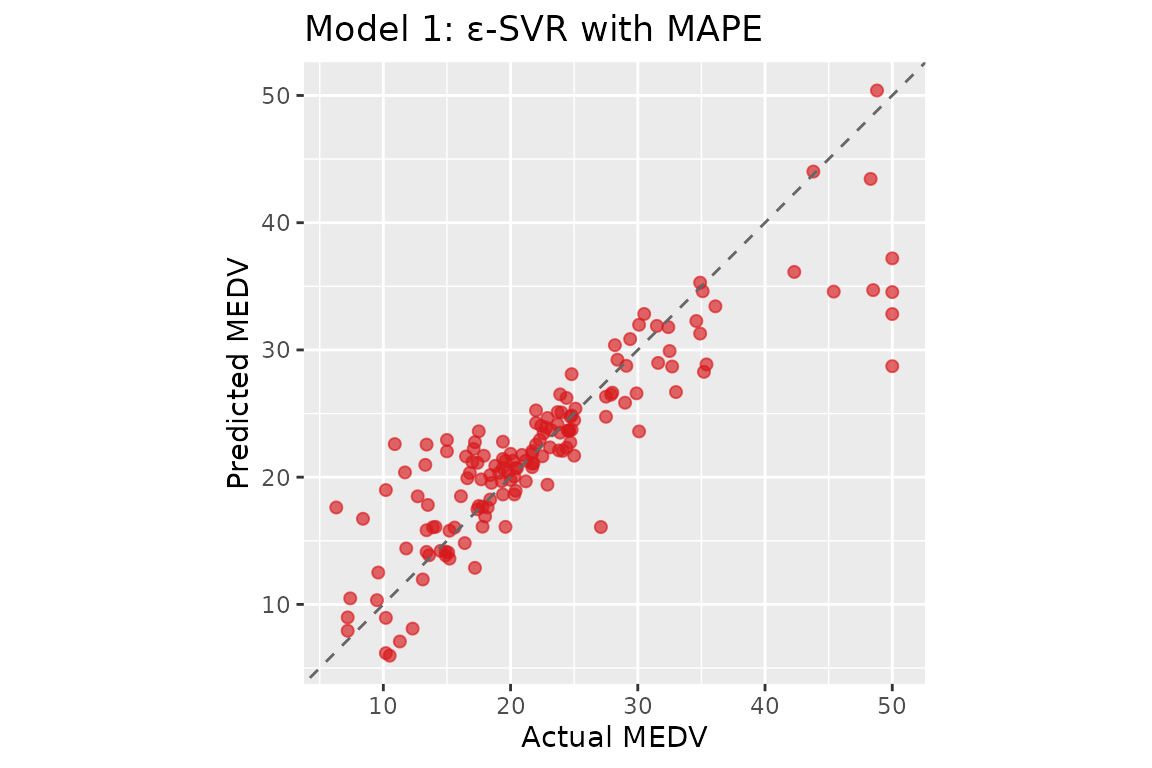
cf_ep <- coef(fit_ep)
# alpha, alpha_star: length-N dual variables (paired); the pre-pruning
#               solution.  Useful as a warm-start across CV folds; for
#               prediction use `beta` instead.
# beta:         beta_k = alpha_k - alpha_k* for each SUPPORT VECTOR only
#               (non-zero only for training points outside the
#               percentage-error ε-tube — sparse)
# b:            bias / intercept term
# support_data: training rows corresponding to support vectors only
cat(sprintf("b = %.4f  |  beta range: [%.4f, %.4f]\n",
            cf_ep$b, min(cf_ep$beta), max(cf_ep$beta)))
#> b = 22.2127  |  beta range: [-83.3333, 62.5000]
Model 3: LS-SVR with RMSPE
The LS-SVR formulation replaces the QP with a linear system by using a quadratic penalty on percentage residuals. The dual reduces to:
where .
# gamma = 5000: regularisation; larger gamma -> smaller Y_Gamma diagonal -> tighter fit.
# This is roughly var(y_tr) * N, the scale cost_psvr_ls_data() computes -- and
# already five times the ceiling of the registered `cost` default. See below.
fit_ls <- psvr_rmspe(X_tr, y_tr, kernel = K, gamma = 5000)
pred_ls <- predict(fit_ls, X_te)

cat(sprintf("LS-SVR RMSPE  — MAPE: %.2f%%  RMSPE: %.2f%%  R²: %.4f\n",
            mape(y_te, pred_ls), rmspe(y_te, pred_ls), r2(y_te, pred_ls)))
#> LS-SVR RMSPE  — MAPE: 11.43%  RMSPE: 14.48%  R²: 0.6845
print(fit_ls)
#>
#> LS-SVR with RMSPE loss  [psvr_rmspe]
#>
#>   Kernel:        RBF (sigma = 2.1195)
#>   Gamma:         5000
#>   Training obs.: 163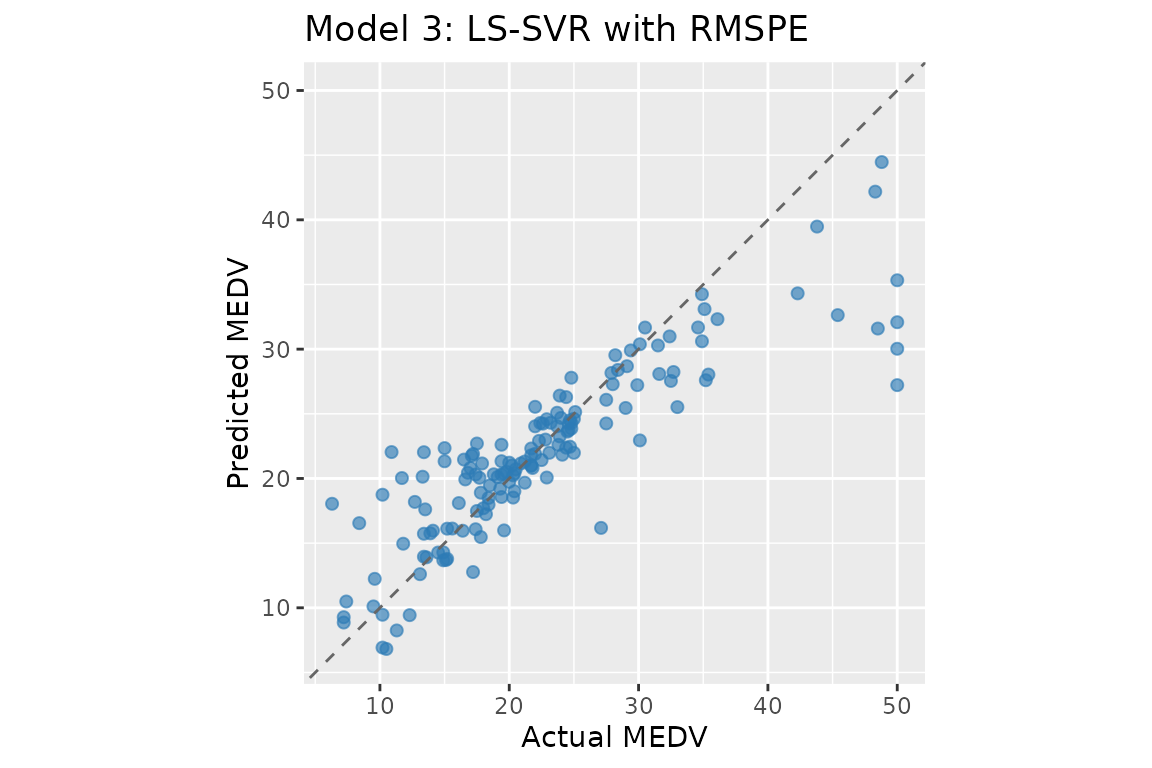
cf_ls <- coef(fit_ls)
# alpha:        N dual variables; weight each training point's kernel
#               contribution in f(x) = sum_k alpha_k K(x_k, x) + b
#               (all N points, no sparsity)
# b:            bias / intercept term
# support_data: all N training inputs stored for prediction
cat(sprintf("b = %.4f  |  alpha range: [%.4f, %.4f]\n",
            cf_ls$b, min(cf_ls$alpha), max(cf_ls$alpha)))
#> b = 23.0976  |  alpha range: [-138.1332, 68.7725]
Comparing objectives
results <- data.frame(
  Model = c("Linear regression", "\u03b5-SVR MAPE (Model 1)",
            "LS-SVR RMSPE (Model 3)"),
  MAPE  = c(mape(y_te,  lm_pred),
            mape(y_te,  pred_ep),
            mape(y_te,  pred_ls)),
  RMSPE = c(rmspe(y_te, lm_pred),
            rmspe(y_te, pred_ep),
            rmspe(y_te, pred_ls)),
  R2    = c(r2(y_te,    lm_pred),
            r2(y_te,    pred_ep),
            r2(y_te,    pred_ls))
)
results[, 2:4] <- round(results[, 2:4], 2)
knitr::kable(results, col.names = c("Model", "MAPE (%)", "RMSPE (%)", "R²"),
             align = "lrrr",
             caption = paste("Test-set performance on ggplot2::mpg",
                             "(70/30 split, RBF kernel, single run,",
"untuned hyperparameters)."))| Model | MAPE (%) | RMSPE (%) | R² |
|---|---|---|---|
| Linear regression | 12.91 | 17.65 | 0.64 |
| ε-SVR MAPE (Model 1) | 11.11 | 14.68 | 0.69 |
| LS-SVR RMSPE (Model 3) | 11.43 | 14.48 | 0.68 |
Both psvr models improve on the linear baseline under their respective percentage-error objectives. The ε-SVR formulation (Model 1) targets MAPE through sample-dependent box constraints on the dual variables; the LS-SVR formulation (Model 3) minimises RMSPE directly.
Read the table for the ordering, not for the magnitudes. It is one split of one small dataset at hyperparameters nobody tuned, so the margins are not evidence about how these models perform in general — that is what the resampled comparison in the When to Use Percentage-Error SVR article is for.
Using psvr with tidymodels
All four models are registered as parsnip engines and integrate
seamlessly with the tidymodels ecosystem. This enables hyperparameter
tuning via tune_grid(), resampling via
rsample, and unified model comparison via
workflow_set().
See the tidymodels workflow
article for a complete example using psvr_rmspe_rbf() with
tune_grid() and data-driven hyperparameter ranges via
rbf_sigma_psvr_data(). The When
to Use Percentage-Error SVR article, on the package website rather
than in the installed package, shows a full workflow_set()
comparison of all four models against standard baselines.
Hyperparameter search ranges
The parsnip specs register static default ranges — a
dials parameter object has to exist before any data does.
Three of them are deliberately conservative, one of them is actively
wrong for LS-SVR, and one searches a level you probably do not want, so
tuning a psvr model means supplying your own ranges through
param_info.
Nothing below fits a model. It builds the parameter set and prints it, before and after.
library(parsnip)
library(tune)

show_ranges <- function(ps) {
  for (i in seq_len(nrow(ps))) {
    ob <- ps$object[[i]]
    cat(sprintf("  %-10s %s\n", ps$id[i],
      if (inherits(ob, "quant_param"))
        sprintf("[%s] on the %s scale",
                paste(signif(unlist(ob$range), 4), collapse = ", "),
                if (is.null(ob$trans)) "identity" else ob$trans$name)
      else sprintf("{%s}", paste(ob$values, collapse = ", "))))
  }
  invisible(ps)
}

spec_mape <- psvr_mape_rbf(cost = tune(), margin = tune(),
                           rbf_sigma = tune(), sym_type = tune()) |>
  set_engine("psvr")

extract_parameter_set_dials(spec_mape) |> show_ranges()
#>   cost       [-2, 10] on the log-2 scale
#>   margin     [1, 20] on the identity scale
#>   rbf_sigma  [-3, 1] on the log-10 scale
#>   sym_type   {none, even, odd}
For an ε-SVR (Models 1–2) only rbf_sigma really needs
replacing; the cost and margin defaults are
usable as they stand.
extract_parameter_set_dials(spec_mape) |>
  update(
    cost      = cost_psvr(),                      # [-2, 10] log2 — fine for C
    margin    = margin_percentage(),              # 1-20% of each target
    rbf_sigma = rbf_sigma_psvr_data(X_tr),        # data-driven; see below
    sym_type  = sym_type_param(c("even", "odd"))  # drops "none"; see below
  ) |>
  show_ranges()
#>   cost       [-2, 10] on the log-2 scale
#>   margin     [1, 20] on the identity scale
#>   rbf_sigma  [-0.6738, 1.326] on the log-10 scale
#>   sym_type   {even, odd}
For an LS-SVR (Models 3–4) cost is
,
and there the registered default is not usable.
spec_ls <- psvr_rmspe_rbf(cost = tune(), rbf_sigma = tune(),
                          sym_type = tune()) |>
  set_engine("psvr")

extract_parameter_set_dials(spec_ls) |>
  update(
    cost      = cost_psvr_ls_data(y_tr),
    rbf_sigma = rbf_sigma_psvr_data(X_tr),
    sym_type  = sym_type_param(c("even", "odd"))
  ) |>
  show_ranges()
#>   cost       [-2, 16.38] on the log-2 scale
#>   rbf_sigma  [-0.6738, 1.326] on the log-10 scale
#>   sym_type   {even, odd}
No single spec carries all four helpers: margin exists
only on the MAPE specs, and cost_psvr_ls_data() applies
only to the RMSPE ones.
rbf_sigma is a length scale, not a precision
Of everything on this page, this is the one most likely to cost you a day. psvr’s RBF kernel is
so rbf_sigma is a length, measured in
the units of the preprocessed feature space, and larger means a
wider kernel. kernlab::rbfdot(sigma =),
e1071::svm(gamma =) and
parsnip::svm_rbf(rbf_sigma =) all use the reciprocal
convention,
,
where larger means narrower. Carrying a tuned value across from
one of those gives a silently wrong kernel width — no error, no warning,
just a worse model.
rbf_sigma_psvr_data() needs preprocessed
predictors
rbf_sigma_psvr_data(X) centres its range on the median
pairwise Euclidean distance between the rows of X, spanning
one decade either side of it on the log10 scale. Being a distance-based
heuristic, it means nothing except on the scale the model is actually
fitted on: pass the standardised predictors (X_tr here, or
the baked output of a recipe), never the raw ones.
sigma_heuristic(X_tr)   # the geometric centre of the range printed above,
#> [1] 2.119499
                        # and the value the fits at the top of this page used
Above sample_size rows (default 500) the median is taken
on a random subsample, so the centre becomes an estimate rather than the
exact median — and a seed-dependent one. Pass seed if you
need it reproducible.
LS-SVR needs cost_psvr_ls_data(), and it cannot be
automated
cost maps to C on the ε-SVR models and to
on the LS-SVR ones, but both register the same default of
on the log2 scale, i.e.
.
That is the ε-SVR range.
enters the LS-SVR system only through the
diagonal, so the value that balances that term against the kernel scales
with var(y) * n — it is not a fixed magnitude, and it grows
with both the spread of the outcome and the size of the training
set.
The fit at the top of this page is already past the default ceiling:
it used gamma = 5000, and
stops at 1024. A grid over the default would be
boundary-trapped — every candidate is legal, the search
reports a plausible number, and the optimum was never inside the range.
The tidymodels workflow article
shows the size of the effect.
cost_psvr_ls_data(y) sets the ceiling from
var(y) * n. It has to be passed by hand: tune
finalises parameters from the molded predictors alone
and never passes the outcome to dials::finalize(), so no
machinery could compute a var(y)-based bound on your
behalf.
cost is not comparable across datasets either
The same trap has a milder form on the ε-SVR side, and
cost_psvr() does not protect you from it. The dual box
constraint is
so the bound a given C imposes depends on the
magnitude of the outcome. On data where y
is of order
rather than order
,
the same C yields a box three decades tighter, every
multiplier saturates against it, and the fit degenerates towards a
constant. cost_psvr() returns a static
calibrated for outcomes of order 10, so on large-y data
C has to be raised by hand to compensate — there is
currently no cost_psvr_data() counterpart to
cost_psvr_ls_data() for the ε-SVR family.
Tuning sym_type cannot answer “does symmetry help”
sym_type registers all three levels,
{none, even, odd}, and "none" is the
asymmetric model. So sym_type = tune() puts Models 1 and 2
— or 3 and 4 — inside a single search space, and
select_best() returns whichever candidate won. That is a
selection, not a comparison. To contrast the two families, fix
sym_type on two specs and compare their resampled metrics.
Restricting to c("even", "odd"), as above, tunes
within the symmetric family, which is a third question
again.
The outcome stays in original units
recipes::step_normalize() applies to predictors. Leave
the outcome alone: the percentage-error losses divide by y,
so they need y > 0 on the original scale, and centring
the outcome would destroy positivity and change what “percentage error”
even refers to. This is a genuine departure from classical SVR, where
rescaling the outcome is routine and harmless.
References
Benavides-Herrera, P., Álvarez, G., Ruiz-Cruz, R., & Sánchez-Torres, J. D. (2026). A unified family of percentage-error support vector regression models with symmetric kernel extensions. Mathematics, 14(10), 1679. https://doi.org/10.3390/math14101679