Exponential smoothing

pbenavides

Mean
\hat y_{T+1\mid T}=\tfrac{1}{T}\sum_{i=1}^T y_i

Naïve
\hat y_{T+1\mid T}=y_T

Mean

Naïve

Exponential Smoothing
\hat y_{T+1\mid T}=\alpha y_T + \alpha(1-\alpha)y_{T-1} + \ldots

  • \alpha \approx 1: naïve-like

  • \alpha \approx 0: mean-like

\hat{y}_{T+1 | T}= \alpha y_{T} + \alpha(1-\alpha) y_{T-1} + \alpha(1-\alpha)^{2} y_{T-2} + \ldots

where 0\leq \alpha \leq1 is the smoothing parameter.

Table 1: Weights for different values of \alpha
\alpha = 0.2 \alpha = 0.4 \alpha = 0.6 \alpha = 0.8
y_t 0.2000 0.4000 0.6000 0.8000
y_{t-1} 0.1600 0.2400 0.2400 0.1600
y_{t-2} 0.1280 0.1440 0.0960 0.0320
y_{t-3} 0.1024 0.0864 0.0384 0.0064
y_{t-4} 0.0819 0.0518 0.0154 0.0013
y_{t-5} 0.0655 0.0311 0.0061 0.0003

Exponential smoothing methods

Simple exponential smoothing (SES)

\begin{aligned} \text{Forecast equation} \quad & \hat{y}_{t+h|t} = \ell_t \\ \text{Smoothing equation} \quad & \ell_t = \alpha y_t + (1-\alpha)\ell_{t-1} \end{aligned}

where \ell_t is the level at time t.

SES has a flat forecast function, so it is appropriate for data with no trend or seasonal pattern.

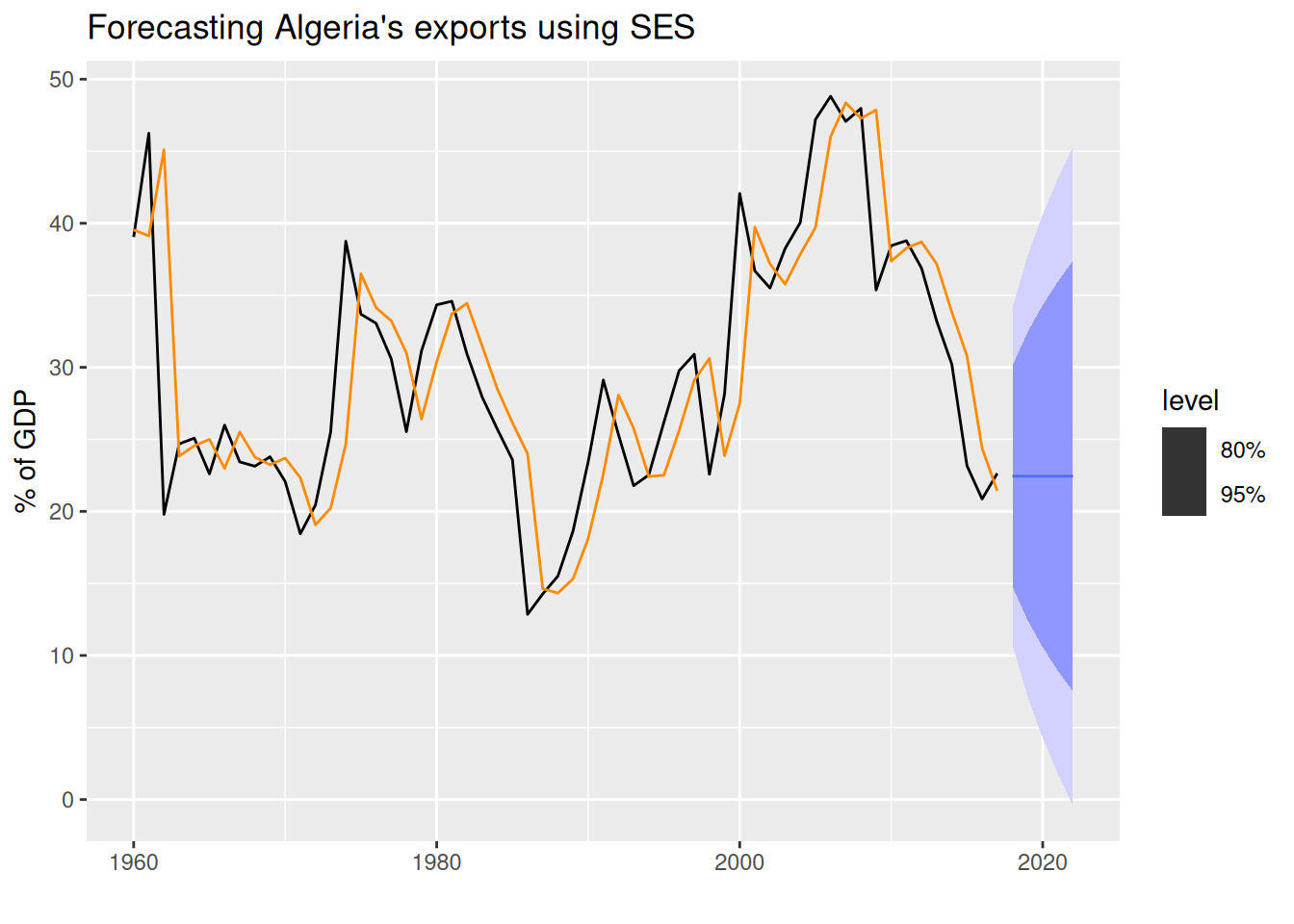
Example: Forecasting Algeria’s exports
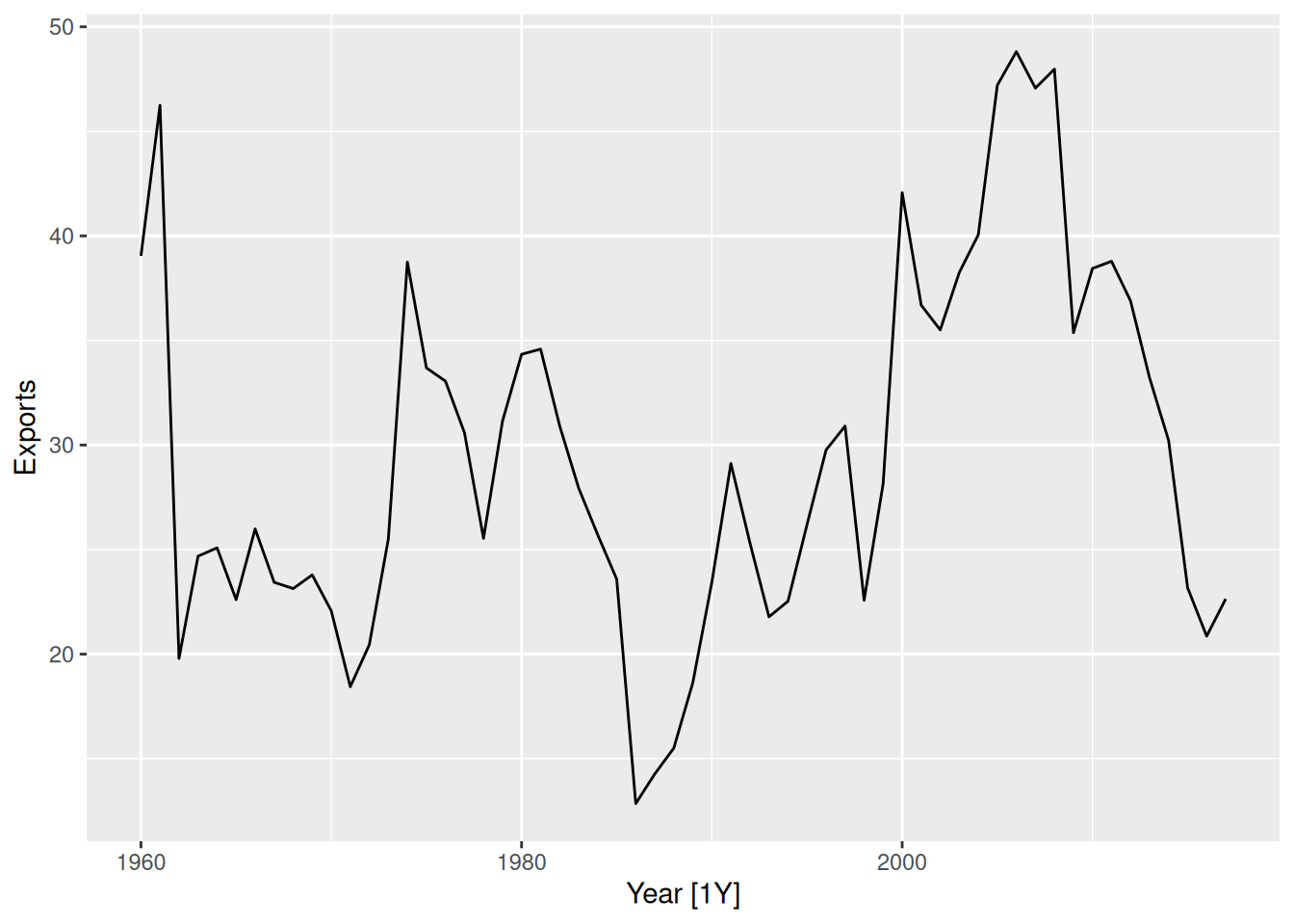
algeria_economy <- global_economy |>
  filter(Country == "Algeria")
  
algeria_economy |> 
  autoplot(Exports)

alg_fit <- algeria_economy |>
  model(
    SES = ETS(Exports ~ error("A") + trend("N") + season("N")),
    Naive = NAIVE(Exports)
  )

alg_fc <- alg_fit |>
  forecast(h = 5)
1
We specify trend("N") and season("N") to indicate that we want a simple exponential smoothing (SES) model, which assumes no trend and no seasonality. The model will estimate the smoothing parameter \alpha automatically.

Obtaining the report() of a model

alg_fit |> 
  select(SES) |> 
  report()
1
The report() function allows us to see a model’s report (the time series modeled, the model used, the estimated parameters, and more). It needs a 1 \times 1 dimension mable1.
Series: Exports 
Model: ETS(A,N,N) 
  Smoothing parameters:
    alpha = 0.8399875 

  Initial states:
   l[0]
 39.539

  sigma^2:  35.6301

     AIC     AICc      BIC 
446.7154 447.1599 452.8968 
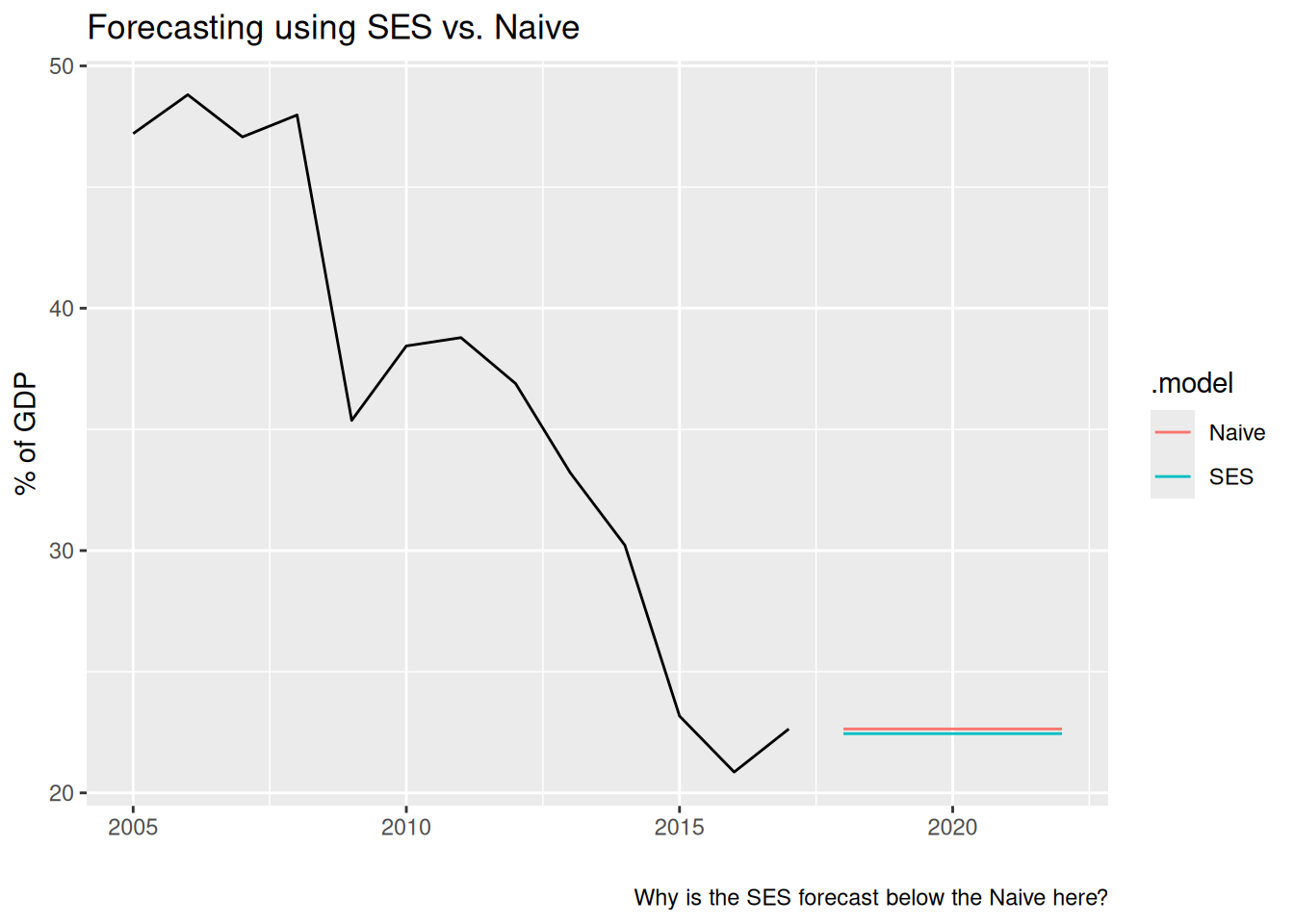
Comparing the SES and Naive forecasts:
Methods with trend

Holt’s linear trend

\begin{aligned} \text{Forecast equation} \quad & \hat{y}_{t+h|t} = \ell_t + hb_t \\ \text{Level equation} \quad & \ell_t = \alpha y_t + (1-\alpha)\ell_{t-1}\\ \text{Trend equation} \quad & b_t = \beta^*(\ell_t - \ell_{t-1}) + (1-\beta^*)b_{t-1} \end{aligned}

where b_t is the growth (or slope) at time t.

When to use Holt’s linear trend method

  • Holt’s linear trend method is appropriate for data with a linear trend but no seasonal pattern.
  • The proper benchmark method to compare against is the drift method.

Example: Forecasting Brazil’s population
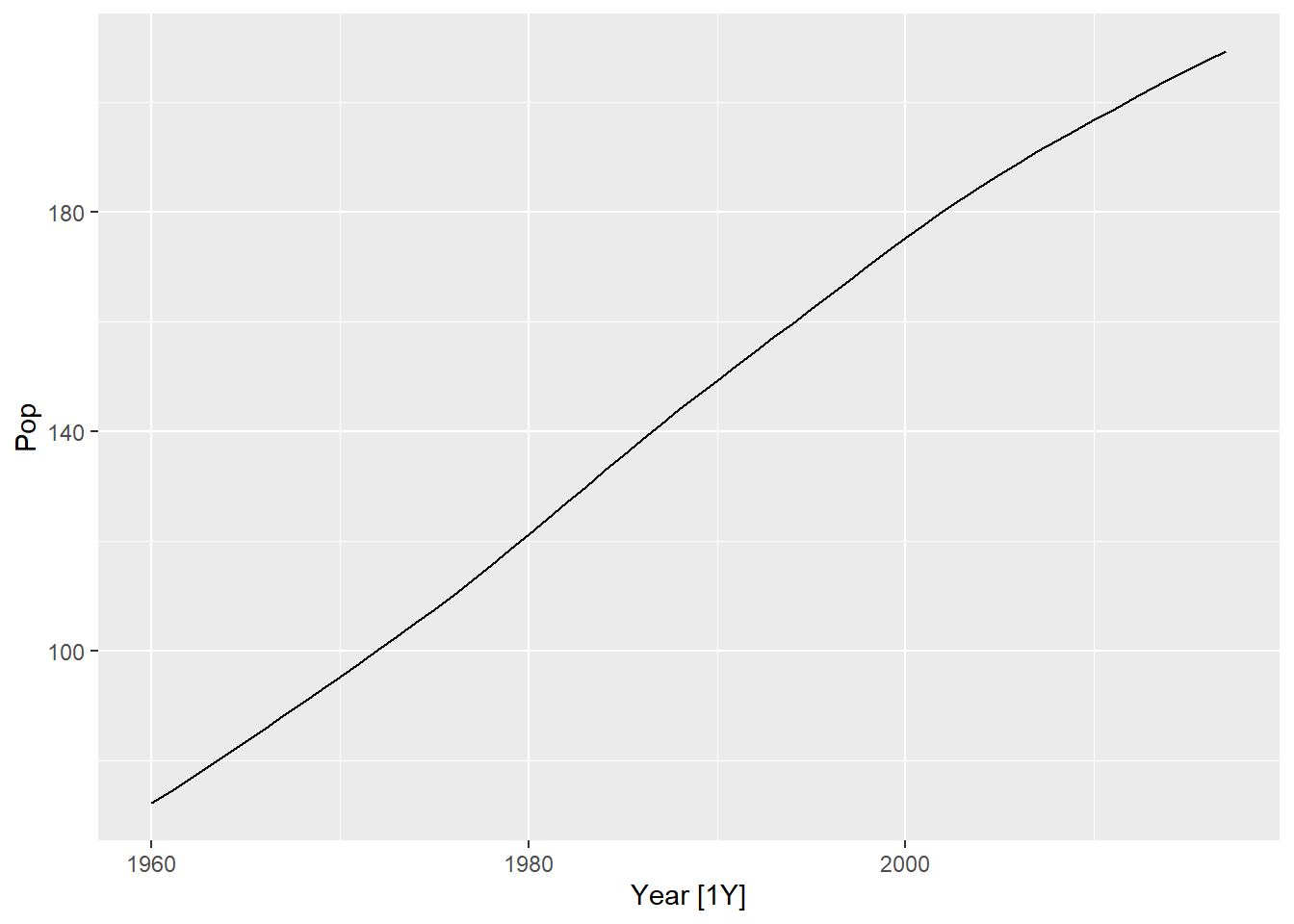
Example: Forecasting Brazil’s population

bra_fit <- bra_economy |> 
  model(
    Holt  = ETS(Pop ~ error("A") + trend("A") + season("N"))
  )

bra_fit

Example: Forecasting Brazil’s population

bra_fit <- bra_economy |> 
  model(
    Holt  = ETS(Pop ~ error("A") + trend("A") + season("N")),
    Drift = RW(Pop ~ drift())
  )

bra_fit

Example: Forecasting Brazil’s population

bra_fit <- bra_economy |> 
  model(
    Holt  = ETS(Pop ~ error("A") + trend("A") + season("N")),
    Drift = RW(Pop ~ drift())
  )

bra_fit |>  
  select(Holt) |>  
  report()
Series: Pop 
Model: ETS(A,A,N) 
  Smoothing parameters:
    alpha = 0.9999 
    beta  = 0.9998999 

  Initial states:
     l[0]     b[0]
 70.06297 2.132884

  sigma^2:  0.0021

      AIC      AICc       BIC 
-115.2553 -114.1014 -104.9531 

Example: Forecasting Brazil’s population

bra_fit <- bra_economy |> 
  model(
    Holt  = ETS(Pop ~ error("A") + trend("A") + season("N")),
    Drift = RW(Pop ~ drift())
  )

bra_fit |>  
  select(Holt) |>  
  report()

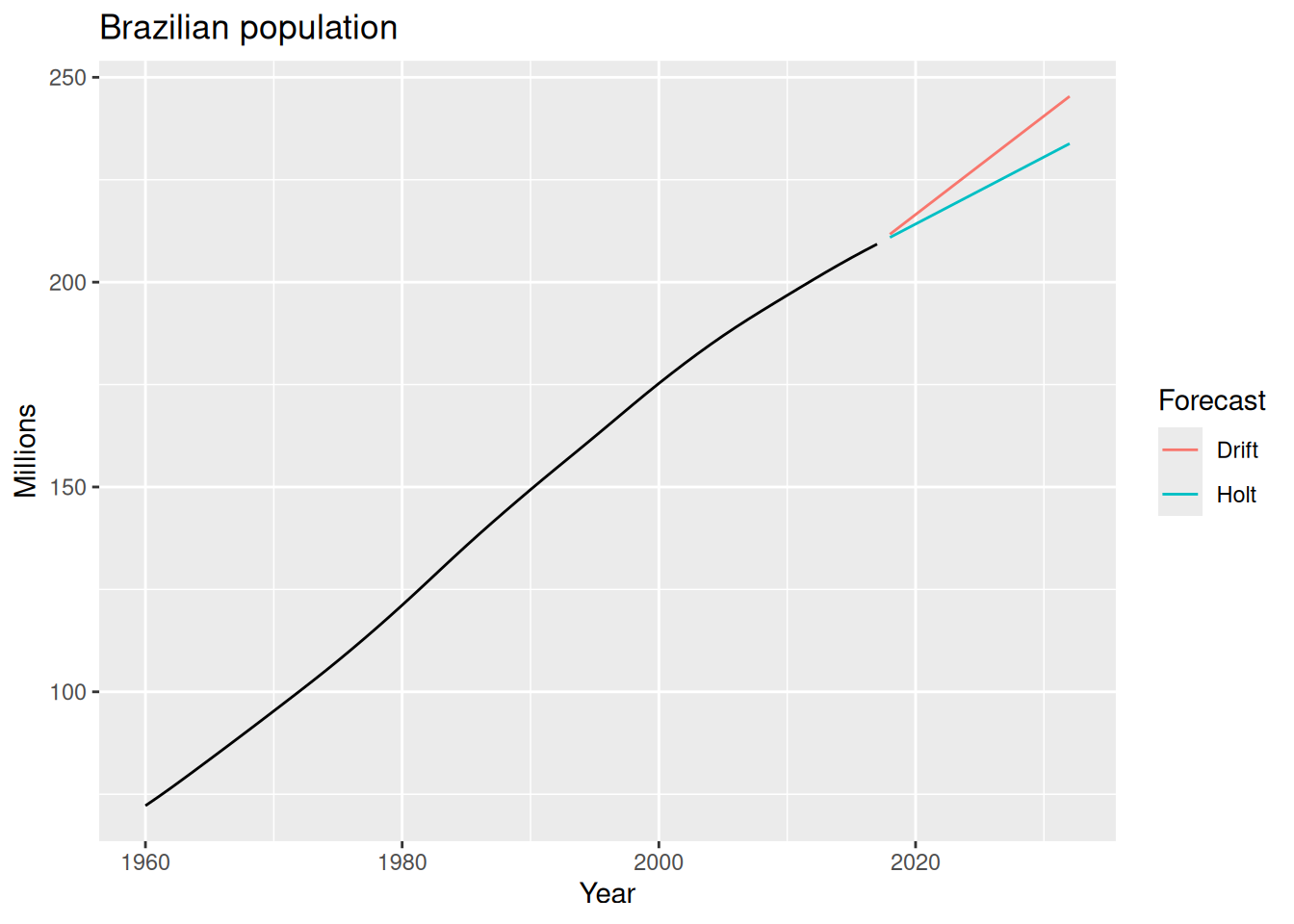
bra_fc <- bra_fit |>  
  forecast(h = 15)

bra_fc |> 
  autoplot(bra_economy, level = NULL) +
  labs(title = "Brazilian population",
       y = "Millions") +
  guides(colour = guide_legend(title = "Forecast"))
1
We specify trend("A") to indicate that we want a linear trend. The model will estimate the smoothing parameters \alpha and \beta^* automatically.
Series: Pop 
Model: ETS(A,A,N) 
  Smoothing parameters:
    alpha = 0.9999 
    beta  = 0.9998999 

  Initial states:
     l[0]     b[0]
 70.06297 2.132884

  sigma^2:  0.0021

      AIC      AICc       BIC 
-115.2553 -114.1014 -104.9531 

Damped trend

\begin{aligned} \text{Forecast equation} \quad & \hat{y}_{t+h|t} = \ell_t + (\phi + \phi^2 + \ldots + \phi^h) b_t \\ \text{Level equation} \quad & \ell_t = \alpha y_t + (1 - \alpha) (\ell_{t-1} + \phi b_{t-1}) \\ \text{Trend equation} \quad & b_t = \beta^*(\ell_t-\ell_{t-1}) + (1-\beta^*)\phi b_{t-1} \end{aligned}

where 0 < \phi < 12 is the damping parameter.

What would happen if \phi = 1? What about if \phi = 0?

  • If \phi = 1, the model reduces to Holt’s linear trend method, meaning the trend continues indefinitely at the same rate.
  • If \phi = 0, the trend component is completely eliminated, and the model behaves like simple exponential smoothing (SES), where forecasts are based solely on the level component without any trend influence.

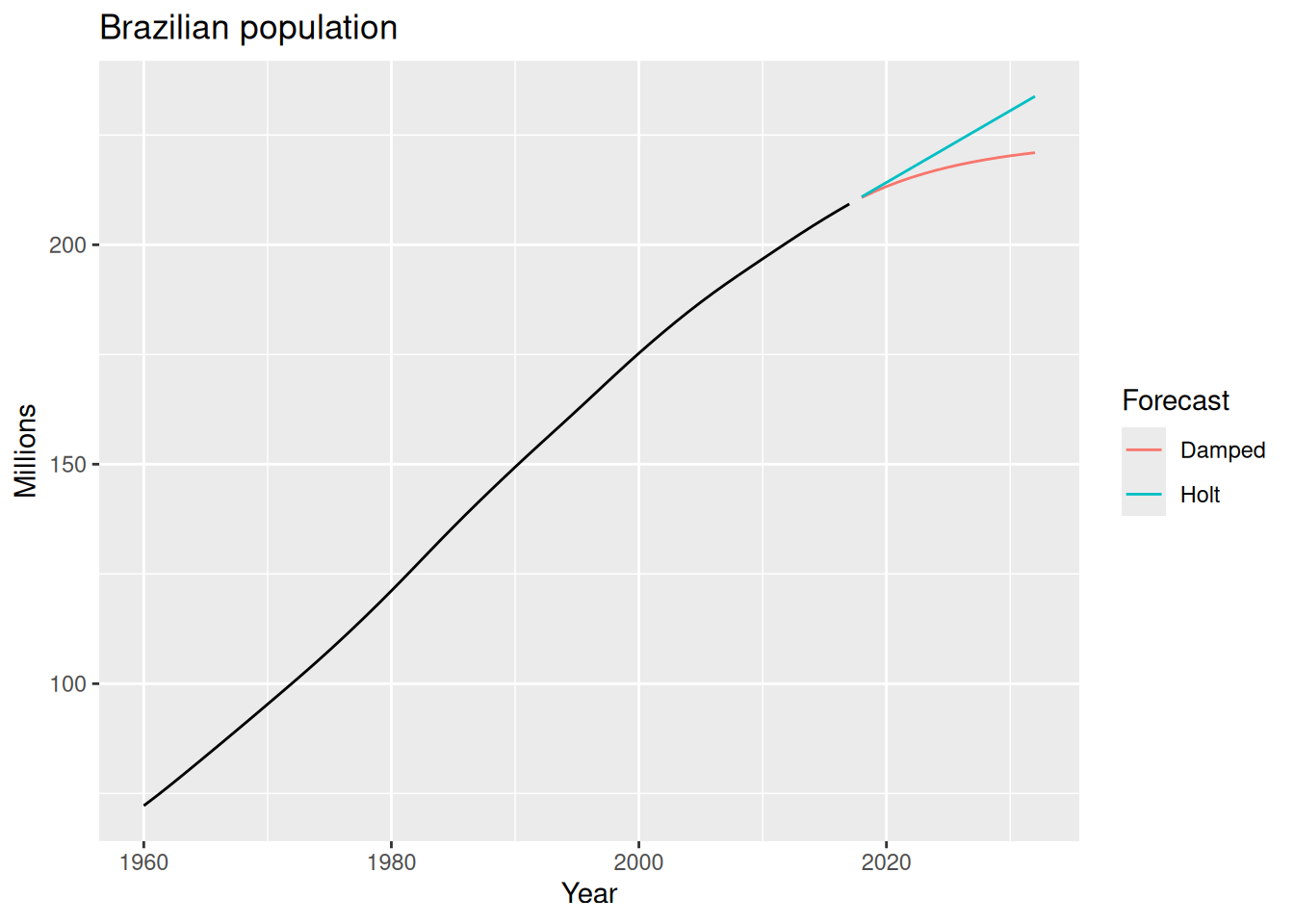
Example: Forecasting Brazil’s population (continued)

bra_economy |> 
  model(
    Holt   = ETS(Pop ~ error("A") + trend("A") + season("N"))
  )

Example: Forecasting Brazil’s population (continued)

bra_economy |> 
  model(
    Holt   = ETS(Pop ~ error("A") + trend("A") + season("N")),
    Damped = ETS(Pop ~ error("A") + trend("Ad", phi = 0.9) + season("N"))
  )

Example: Forecasting Brazil’s population (continued)

bra_economy |> 
  model(
    Holt   = ETS(Pop ~ error("A") + trend("A") + season("N")),
    Damped = ETS(Pop ~ error("A") + trend("Ad", phi = 0.9) + season("N"))
  ) |> 
  forecast(h = 15) |> 
  autoplot(bra_economy, level = NULL) +
  labs(title = "Brazilian population",
       y = "Millions") +
  guides(colour = guide_legend(title = "Forecast"))
1
We specify trend("Ad") to indicate that we want a damped trend, and phi = 0.9 sets the damping parameter to 0.9. We could also let the model estimate \phi automatically by omitting the phi argument.

Methods with seasonality

Holt-Winters method

HW - Additive

\begin{aligned} \text{Forecast equation} \quad & \hat{y}_{t+h|t} = \ell_t + hb_t + s_{t+h-m(k+1)} \\ \text{Level equation} \quad & \ell_t = \alpha (y_t - s_{t-m}) + (1 - \alpha) (\ell_{t-1} + b_{t-1}) \\ \text{Trend equation} \quad & b_t = \beta^*(\ell_t-\ell_{t-1}) + (1-\beta^*) b_{t-1} \\ \text{Seasonal equation} \quad & s_t = \gamma(y_t - \ell_{t-1} - b_{t-1}) + (1-\gamma)s_{t-m} \end{aligned}

where s_t is the seasonal component at time t, m is the period of the seasonality3, and k = \lfloor (h-1)/m \rfloor.

HW - Multiplicative

\begin{aligned} \text{Forecast equation} \quad & \hat{y}_{t+h|t} = (\ell_t + hb_t) s_{t+h-m(k+1)} \\ \text{Level equation} \quad & \ell_t = \alpha \frac{y_t}{s_{t-m}} + (1 - \alpha)(\ell_{t-1} + b_{t-1}) \\ \text{Trend equation} \quad & b_t = \beta^*(\ell_t-\ell_{t-1}) + (1-\beta^*) b_{t-1} \\ \text{Seasonal equation} \quad & s_t = \gamma \frac{y_t}{\ell_{t-1} + b_{t-1}} + (1-\gamma)s_{t-m} \end{aligned}

When to use Holt-Winters methods

  • Holt-Winters methods are appropriate for data with a trend and seasonal pattern.
  • Use an additive model when the seasonal fluctuations are roughly constant over time.
  • Use a multiplicative model when the seasonal variation increase or decrease over time.
  • The proper benchmark method to compare against is the seasonal naïve method. for seasonal data.
    • If the data contains both trend and seasonality, then A decomposition model using STL4 + Drift5 + SNAIVE6 is often a strong competitor.

Example: Forecasting Australian holiday trips
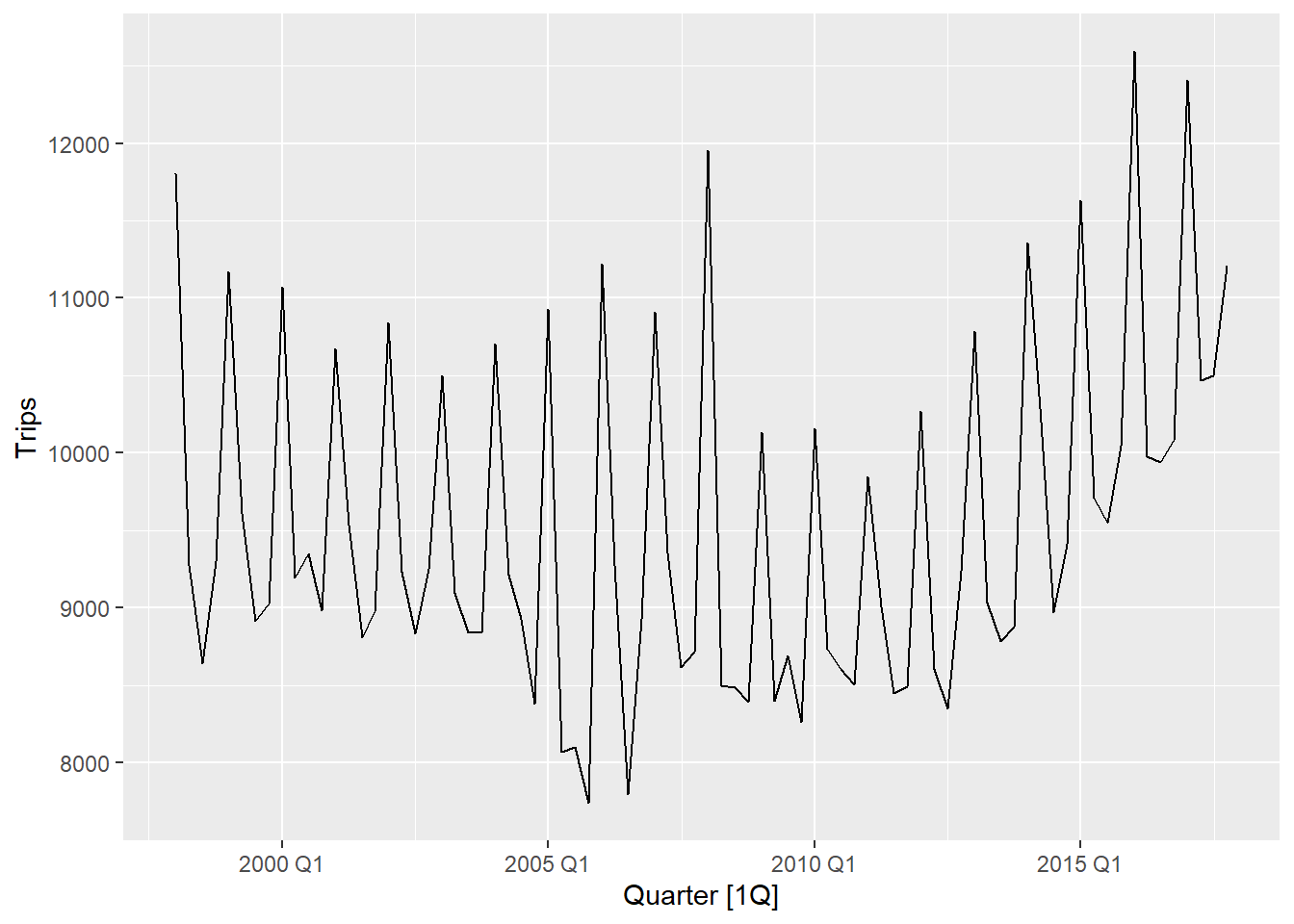
aus_holidays <- tourism |> 
  filter(Purpose == "Holiday") |>
  summarise(Trips = sum(Trips))

aus_holidays

Example: Forecasting Australian holiday trips

aus_holidays <- tourism |> 
  filter(Purpose == "Holiday") |>
  summarise(Trips = sum(Trips))

aus_holidays |>
  autoplot(Trips)

Example: Forecasting Australian holiday trips

aus_fit <- aus_holidays |> 
  model(
    Additive       = ETS(Trips ~ error("A") + trend("A") + season("A"))
  )

Example: Forecasting Australian holiday trips

aus_fit <- aus_holidays |> 
  model(
    Additive       = ETS(Trips ~ error("A") + trend("A") + season("A")),
    Multiplicative = ETS(Trips ~ error("M") + trend("A") + season("M"))
  )

Example: Forecasting Australian holiday trips

The tidy() function for models

aus_fit |> 
  tidy()
1
The tidy() function allows us to see the estimated parameters of each model in a tidy table.

Example: Forecasting Australian holiday trips

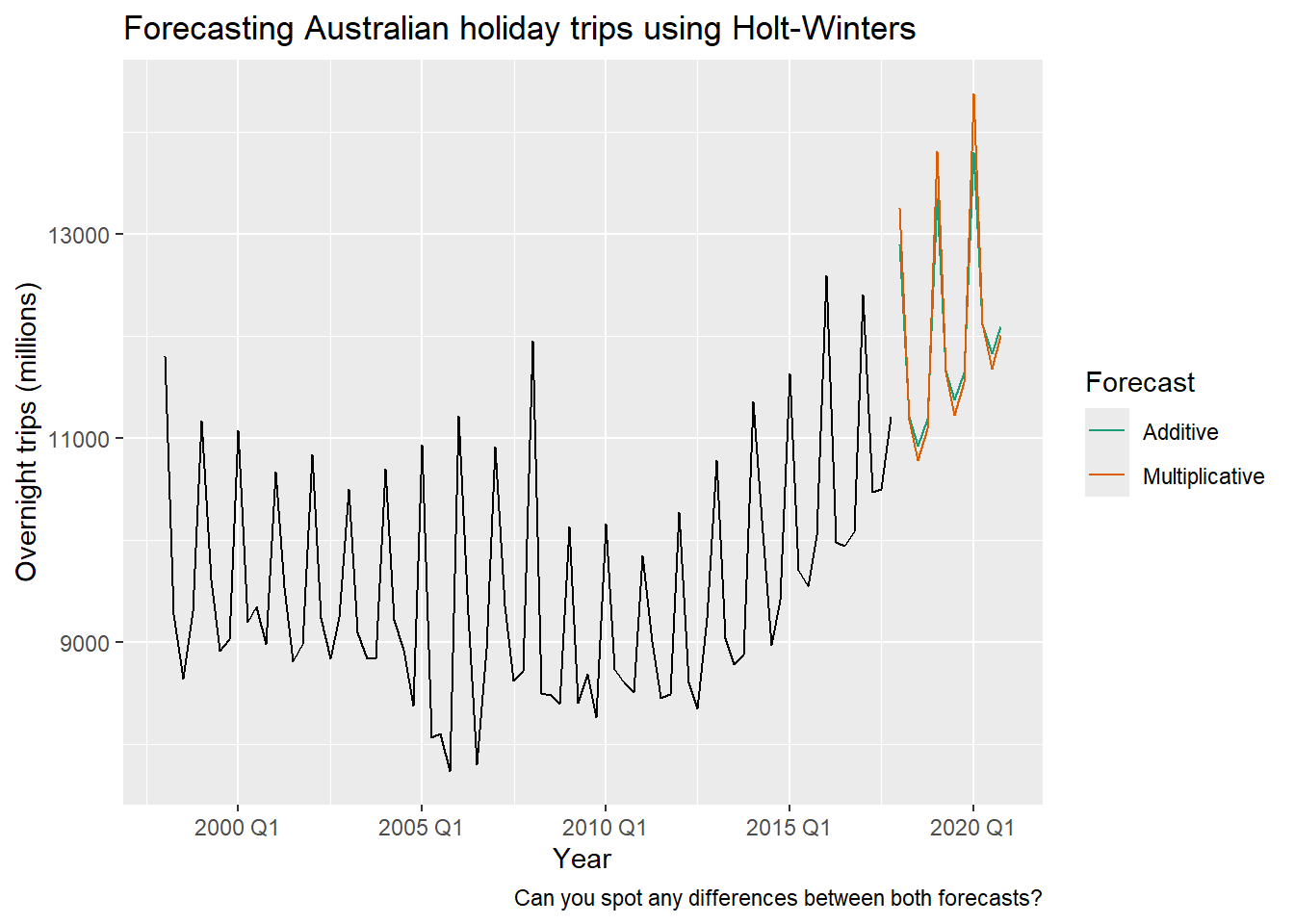
aus_fc <- aus_fit |> 
  forecast(h = "3 years")
aus_fc |> 
  autoplot(aus_holidays, level = NULL) + xlab("Year") +
  labs(
    title   = "Forecasting Australian holiday trips using Holt-Winters",
    y       = "Overnight trips (millions)",
    caption = "Can you spot any differences between both forecasts?"
  ) +
  scale_color_brewer(type = "qual", palette = "Dark2") +
  guides(colour = guide_legend(title = "Forecast"))
Holt-Winters’ damped method

\begin{aligned} \text{Forecast equation} \quad & \hat{y}_{t+h|t} = [\ell_t +(\phi + \phi^2 + \ldots + \phi^h)b_t] s_{t+h-m(k+1)} \\ \text{Level equation} \quad & \ell_t = \alpha \frac{y_t}{s_{t-m}} + (1 - \alpha)(\ell_{t-1} + b_{t-1}) \\ \text{Trend equation} \quad & b_t = \beta^*(\ell_t-\ell_{t-1}) + (1-\beta^*) \phi b_{t-1} \\ \text{Seasonal equation} \quad & s_t = \gamma \frac{y_t}{\ell_{t-1} + \phi b_{t-1}} + (1-\gamma)s_{t-m} \end{aligned}

Example: Forecasting daily pedestrian traffic

sth_cross_ped <- pedestrian |>
  filter(Date >= "2016-07-01",
         Sensor == "Southern Cross Station") |>
  index_by(Date) |>
  summarise(Count = sum(Count)/1000)

sth_cross_ped |>
  filter(Date <= "2016-07-31") |>
  model(
    hw = ETS(Count ~ error("M") + trend("Ad") + season("M"))
  ) |>
  forecast(h = "2 weeks") |>
  autoplot(sth_cross_ped |> filter(Date <= "2016-08-14")) +
  labs(title = "Daily traffic: Southern Cross",
       y="Pedestrians ('000)")
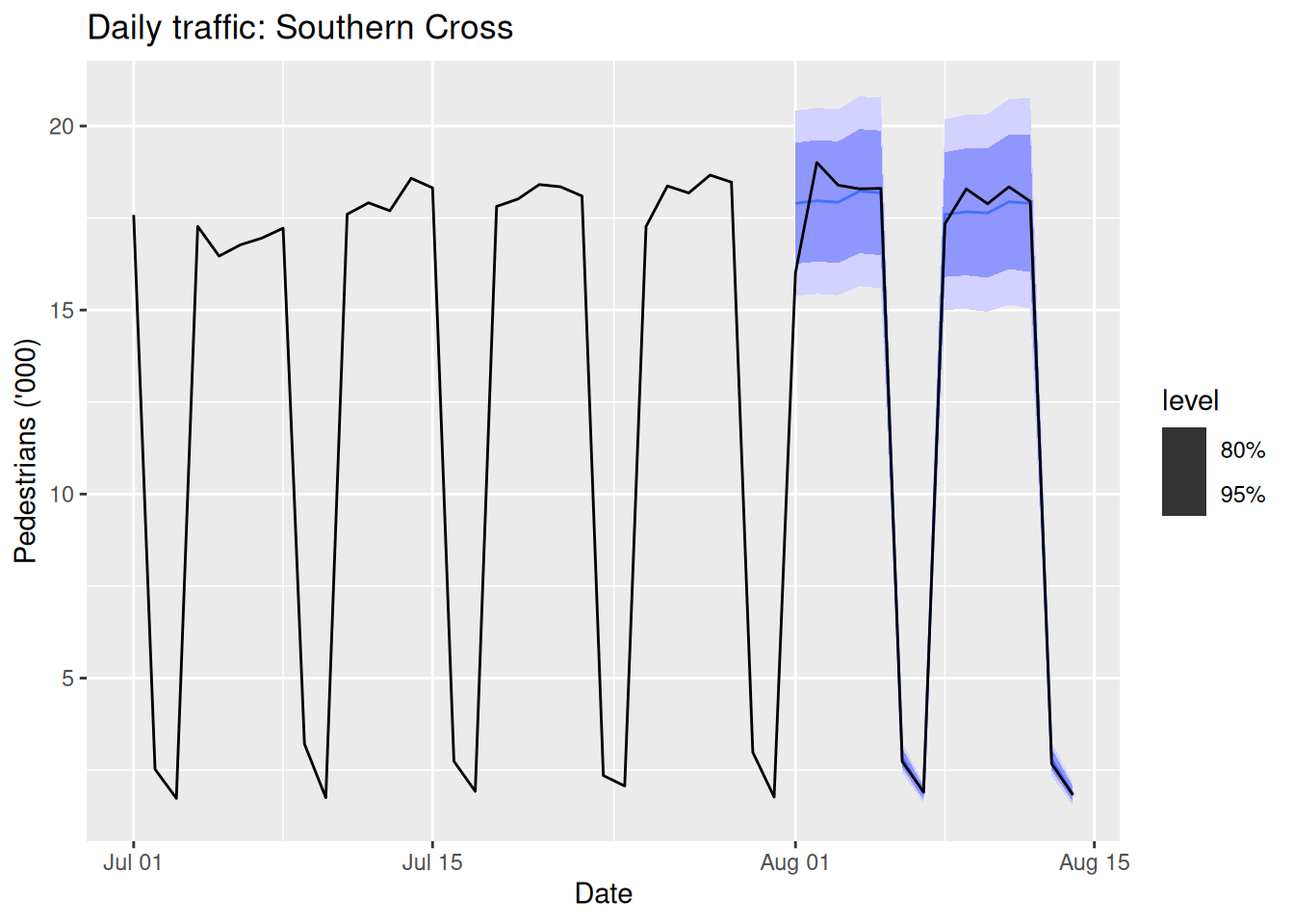
The setup ETS(y ~ error("M") + trend("Ad") + season("M")) is often a robust choice for seasonal data with trend.

Automatic ETS selection

Example: Forecasting daily pedestrian traffic (continued)

ped_fit <- pedestrian |> 
  filter(
    Date >= "2016-07-01",
    Sensor != "Birrarung Marr"
  ) |> 
  index_by(Date) |>
  group_by_key() |> 
  summarise(Count = sum(Count)/1000) |> 
  model(
    ETS_auto       = ETS(Count),                       
    ets_with_trend = ETS(Count ~ trend(c("A", "Ad"))), 
  )

ped_fit                            

The lineup of exponential smoothing methods

Table 2: ETS component combinations (trend × seasonal)
Trend component N (None) A (Additive) M (Multiplicative)
N (None) (N,N), (N,A) (N,M)
A (Additive) (A,N), (A,A) (A,M)
A_d (Additive damped) (A_d,N), (A_d, A) (A_d,M)
Table 3: Names of some popular ETS models
Notation Method
(N,N) Simple Exponential Smoothing (SES)
(A,N) Holt’s Linear Trend
(A_d,N) Additive damped Trend
(A,A) Holt-Winters’ Additive
(A,M) Holt-Winters’ Multiplicative
(A_d,M) Holt-Winters’ damped

In summary

  • Exponential smoothing methods are a family of forecasting methods that use weighted averages of past observations to make forecasts.
  • The weights decrease exponentially for older observations, controlled by smoothing parameters.
  • Different configurations of ETS models can be used to handle various data patterns, including trend and seasonality.
  • The choice of model components (error(c("A", "M")), trend(c("N", "A", "Ad")), seasonality(c("N", "A", "M"))) should be based on the characteristics of the data.
    • That is, we choose the model by viewing the time plot.
  • Automatic ETS selection can be a powerful tool for fitting models to multiple time series efficiently.

Footnotes

  1. (i.e., a mable containing only one model and one time series.)

  2. In practice, we restrict 0.8 \leq \phi \leq 0.98 because the damping effect would be too great for smaller values than 0.8 and almost non distinguishable from a linear trend for greater values than 0.98.

  3. e.g., m=4 for quarterly data, m=12 for monthly data, …

  4. as the decomposition method

  5. for the seasonally adjusted series

  6. for the seasonal component